A portable air conditioner marked 14,000 BTU won't put 14,000 BTU into your garage. Run the federal test that accounts for heat bleeding back through the exhaust hose and hot air sneaking in under the door, and the working figure drops by thousands. That gap explains nearly every complaint I hear about these machines. It also explains why a garage air conditioner has to be chosen on completely different terms than something you'd roll into a spare bedroom, because your garage sits uninsulated, cut off from the ductwork, and stacked with surfaces that soak up sun all afternoon and hand it back all evening.
TL;DR Quick Answers
garage air conditioner
A garage air conditioner has to be sized against the real heat load, not the square footage. Uninsulated doors, no ductwork, and stored engine heat push the requirement well above what the same space would need indoors. Compare units by SACC, and seal the door before you buy.
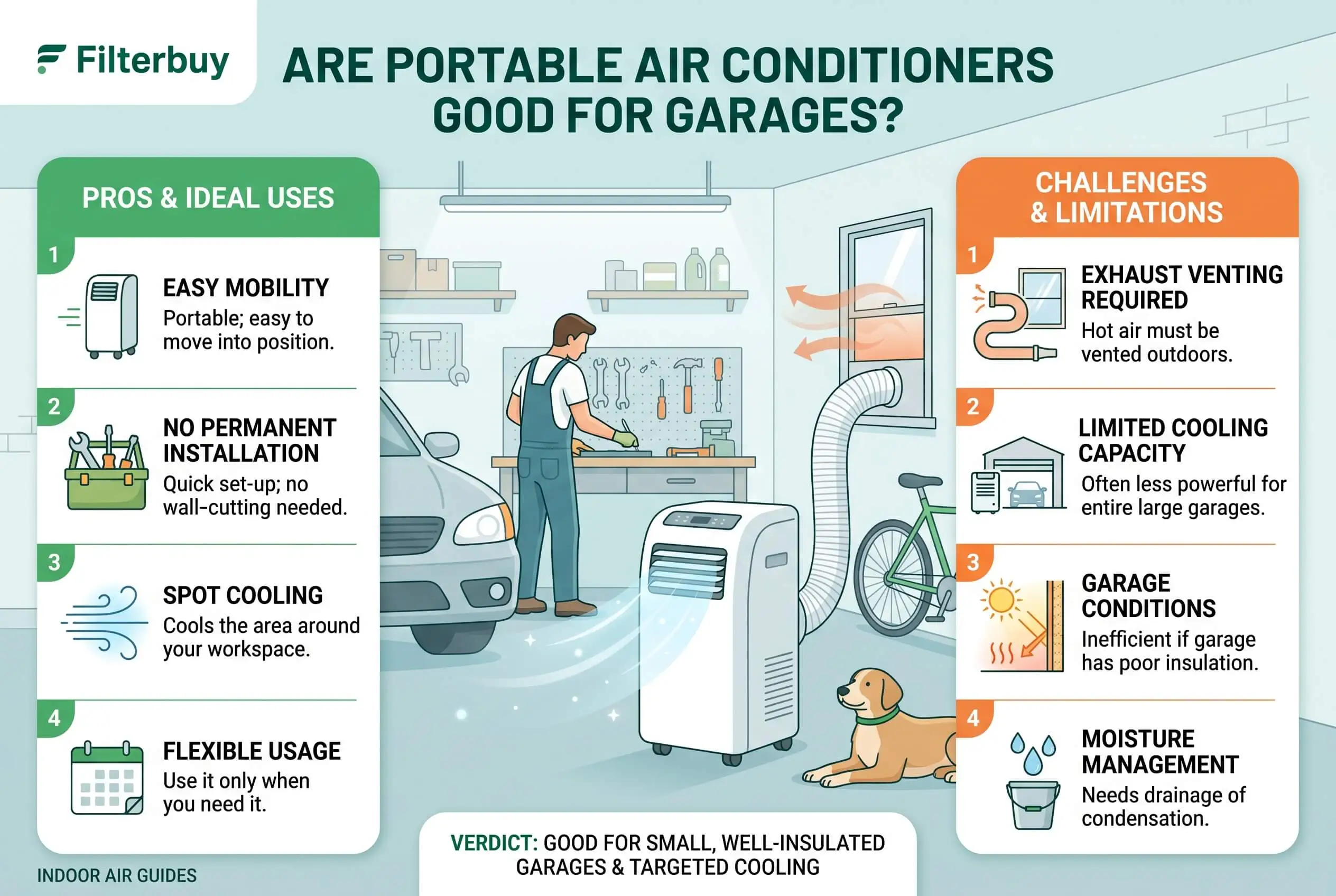
Sizing by bay: 9,000 to 12,000 BTU for one car, 12,000 to 18,000 for two, past 18,000 for three bays or a high ceiling.
Check SACC, not the box: the federal rating sits thousands of BTU below the advertised number.
Portables struggle here: a single-hose unit depressurizes a leaky garage and pulls the hot outdoor air right back in.
Window and ductless units cool more efficiently: ENERGY STAR excludes portable air conditioners by name.
Insulate before you spend: a bottom seal and a door panel kit cut the load every unit has to fight.
Top Takeaways
Compare units by SACC, not the box number. The advertised BTU rating comes from lab conditions your garage will never produce.
Single-hose units depressurize the room. In a leaky garage they pull in the same hot outdoor air they are working to remove.
No portable carries an ENERGY STAR label. The specification excludes the whole category by name.
Insulation comes before equipment. A door seal and a panel kit lower the load that every later purchase has to overcome.
Venting, drainage, wiring, and dust decide feasibility. A garage with no window, no floor drain, and one shared circuit is a poor candidate no matter which unit you pick.
Portables are strong at spot cooling. Cooling one person at a bench is a job they do well and cheaply.
Why Your Garage Fights Back
Cooling a garage is harder than cooling any other room in the house, and the reasons stack on each other.
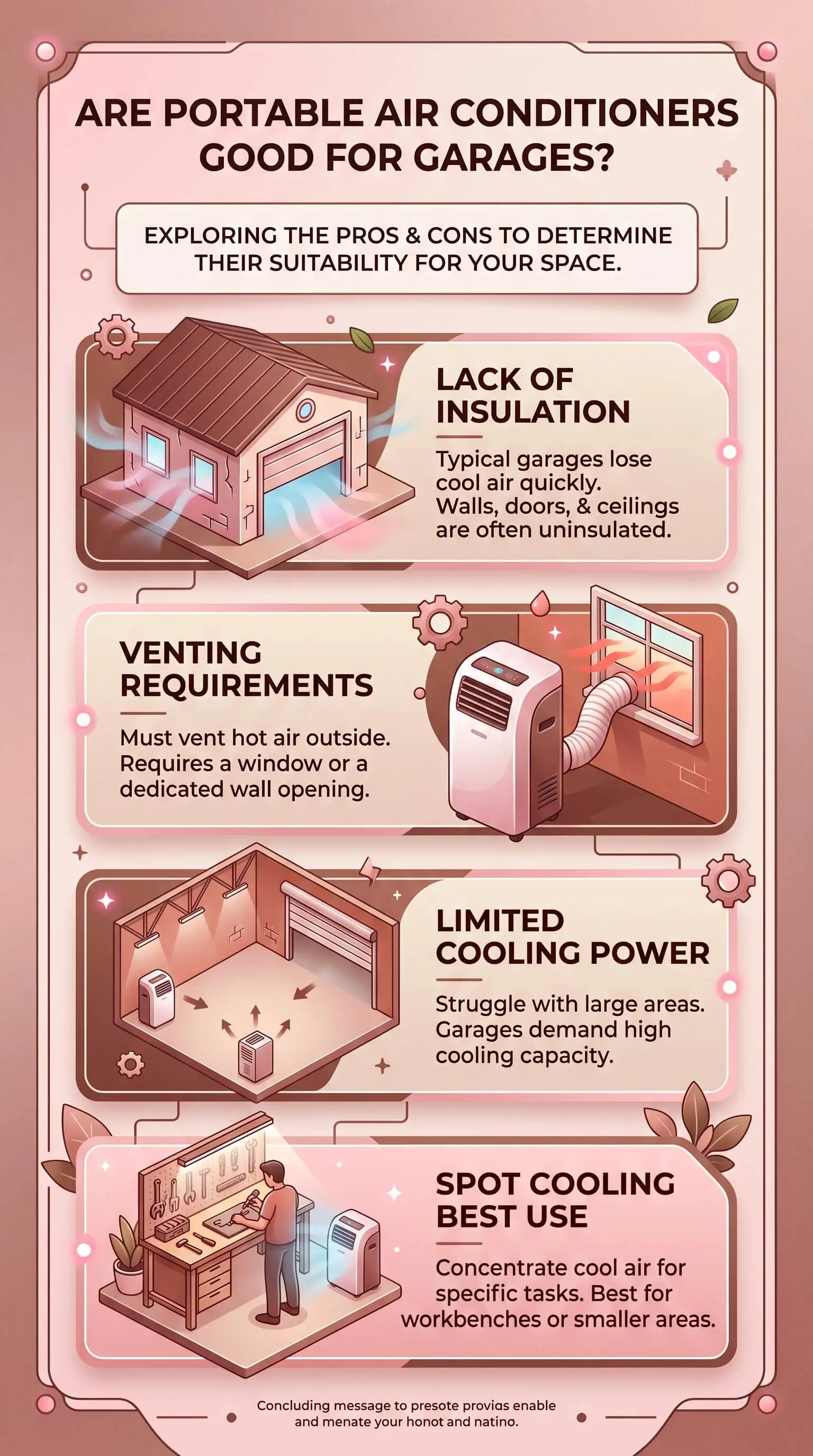
The envelope. Most garage doors are one skin of steel or a thin panel with nothing behind it, and the walls facing the outdoors are often bare studs. The sun loads that surface through the afternoon. It keeps pushing heat inward long after the sun has moved off it.
No ductwork. Builders leave the garage off the home's central system as a matter of course. Nothing conditioned reaches the space, no thermostat is asking on its behalf, and the room just tracks the outdoors plus whatever it has stored.
Stored heat. Park a car you've just driven and the engine block and brakes keep radiating for hours. Add a chest freezer, an air compressor, a row of shop lights, and the room starts making its own cooling load.
The door. Every time it goes up, you dump the entire room's air and start over. A garage you're actually using is a garage that keeps opening.
Insulation is the cheapest correction on that list, and it belongs first. A bottom seal and a door panel kit cost a fraction of any cooling equipment, and they cut the load that every unit you buy afterward has to fight. Better insulation lowers the load before you spend on equipment.
What the Number on the Box Hides
Every one of these machines runs the same vapor-compression cycle as your home system. It moves heat instead of destroying it, and that heat has to land somewhere outside the room. How honestly a manufacturer measures the move is where the two capacity figures come from.
The big number on the packaging is usually an ASHRAE-style rating taken in a controlled chamber. The smaller one is SACC, short for seasonally adjusted cooling capacity, and the Department of Energy built it because the older figure flattered these units badly.
Under the federal test procedure, SACC averages cooling performance across two different outdoor conditions, then subtracts heat coming back through the exhaust duct along with the infiltration air pulled in to replace whatever the unit blew outside. DOE test procedure for portable air conditioners.
Nobody is lying to you. The two figures answer two different questions, and only one of them is about your room. Size a garage against the marketing number and you'll buy a machine that can't hold the space.
Pro tip: the SACC figure lives on the EnergyGuide label and the spec sheet, not the front of the box. Find it before you look at anything else.
Single Hose Versus Dual Hose, and Why It Decides Everything Here
This is the part that determines the outcome in a garage, and almost nobody explains it.
A single-hose unit pulls air out of the room, runs it across the coil, and pushes some of it outside through the exhaust. The air that leaves has to come back from somewhere. In a sealed bedroom it trickles in slowly. In a garage it pours in under the door, around the frame, and through every gap somebody drilled for a cable. That incoming air is the hot outdoor air the machine is fighting — so a share of its capacity goes to undoing its own work.
A dual-hose unit takes condenser air from outside through a second duct and sends it straight back out, so it never depressurizes the room the same way. In a leaky space, the gap between the two designs is wide.
One more thing people miss. That exhaust hose runs hot along its whole length, and it sits inside the room you're trying to cool. In a single-bay garage, you've paid for a radiator.
There's No Such Thing as an ENERGY STAR Portable Unit
If you went hunting for a certified efficient portable and came up empty, you didn't miss it. The ENERGY STAR room air conditioner specification names portable air conditioners as excluded products, listed right alongside packaged terminal units and models that heat by electric resistance. ENERGY STAR room air conditioner program requirements.
Read the exclusion as a signal. Window units and through-the-wall units can earn the label. Portables cannot. When you're weighing the two for the same garage, that difference has already told you where the efficiency sits.
Venting, Water, Wiring, and Dust
Four installation problems show up in garages that rarely bite you anywhere else in the house.
Venting. The exhaust has to end up outside. Plenty of garages have no window at all, which leaves you cutting a wall or door penetration, or cracking the main door and giving away the seal you were counting on. Snaking the hose out under a partly raised door undoes the whole exercise.
Water. Cooling pulls moisture out of the air, and a garage with an open door and no vapor barrier is a humid room. Some units evaporate most of that water out through the exhaust. Others collect it in a tank and shut down when the tank fills. No floor drain in the space means you're choosing between a gravity drain line you route yourself and a bucket you empty by hand.
Wiring. Garage receptacles often share a circuit with the door opener, a freezer, a compressor, and bench tools. Start a compressor motor while the saw is running and the breaker goes. Larger units also fall under garage receptacle protection requirements in current electrical code, which is worth checking against what your panel can actually carry. Find out what's on that circuit first.
Dust. Sawdust and tire grit load a portable unit's filter far faster than household dust loads a furnace filter. Clean it monthly through the season. Let it clog and airflow drops, which costs you the capacity you already paid for. Filter strategy in high-dust environments.
One safety point for attached garages. Never run a vehicle or any fuel-burning engine in an enclosed garage, even with the door open, and never put a generator in there. CPSC guidance on carbon monoxide in the home.
Sizing a Garage Air Conditioner Honestly
Bay count gets you close to a well-insulated space. A single-car garage of roughly 250 to 300 square feet lands in the 9,000 to 12,000 BTU range. Two cars at 400 to 600 square feet pushes toward 12,000 to 18,000, and three bays or a high ceiling takes you past 18,000.
Now apply both corrections. Compare by SACC rather than the marketing figure, then add capacity for an uninsulated envelope instead of sizing to bare square footage.
Do that and the math usually breaks. A portable sized honestly for a two-car garage needs a seasonally adjusted capacity that consumer portables don't reach. That's the point where most people stop shopping for portables and start comparing window units, AC replacement options, and ductless systems, and it's worth reading a full breakdown of garage cooling options before you commit either way.
When a Portable Actually Wins
I don't think these machines are useless. I think they're mismatched to the job most people buy them for. A portable earns its place when at least one of these is true:
You're renting and can't cut a wall or mount permanent equipment
You need cooling for a couple of hours at a stretch, not all summer
The garage is a single bay with a usable window and a door that genuinely seals
You want to cool the person at the workbench instead of the whole room
That last one is the strongest by a wide margin. Aim the discharge where you're standing, accept that the room stays warm, and a portable does honest work. Ask it to serve as the room air conditioner for an uninsulated two-car garage and it will disappoint you every August.
"The call almost never turns out to be a broken unit. It's that the thing runs nonstop and the room never gets cold, and most times I find a single-hose portable venting through a gap in a garage door that's pulling outdoor air back in as fast as the unit can shove it out. What fixes that is a bottom seal and a real wall penetration, not a bigger machine."
7 Essential Resources
1. The Federal Rule That Rewrote How Portable AC Capacity Gets Measured
The clearest account of why SACC exists and what it corrects for, including duct heat transfer and infiltration air. Worth reading at the source rather than through a retailer's summary. Energy Conservation Program: Test Procedure for Portable Air Conditioners, Federal Register
2. Proof That Portable Units Cannot Earn an Efficiency Label
The specification lists portable air conditioners among the excluded products by name. Useful ammunition when a product listing implies a certification that does not exist for the category. ENERGY STAR Room Air Conditioners Specification and Partner Commitments
3. What to Read Before You Seal an Attached Garage Tighter
Tightening a garage improves cooling and traps everything else in the air along with it. Straight guidance on carbon monoxide sources, alarm placement, and why a running vehicle in an enclosed garage is never acceptable. Carbon Monoxide Questions and Answers, U.S. Consumer Product Safety Commission
4. What Heat Actually Does to You in an Enclosed Workspace
Heat degrades fine motor performance before you feel unwell, which matters a great deal if your garage doubles as a workshop. A useful benchmark for deciding how much cooling the space really needs. Working in Outdoor and Indoor Heat Environments, OSHA
5. The Free Fixes Worth Trying Before You Buy Anything
Engineering and administrative controls for hot work environments. Several of them translate straight to a home garage at no cost, and they belong ahead of any purchase. Heat Stress Guide, OSHA
6. How American Homes Actually Cool Themselves
Equipment-type breakdowns from the national residential energy survey, including how common individual units are next to central systems. Good context for judging whether a portable is a normal choice in your situation or an outlier. Residential Energy Consumption Survey reports, U.S. Energy Information Administration
7. The Reference Behind BTU, Tons, and Watts
For converting between the units manufacturers use and checking a spec claim yourself, this is the authoritative definition set. One ton of refrigeration equals 12,000 BTU per hour, or roughly 3,517 watts. NIST Special Publication 330, The International System of Units
These resources cover portable AC efficiency, BTU sizing, heat safety, garage ventilation, and practical ways to improve cooling performance, with MERV 8 pleated HVAC furnace air filters supporting cleaner airflow in compatible filtered HVAC systems.
3 Statistics
88 percent of U.S. households used air conditioning in 2020. Individual units, meaning window, wall, mini split, and portable, serve as the main cooling equipment for half of Northeast households. U.S. Energy Information Administration
Air conditioning ate about 19 percent of household electricity in 2020. That works out to 254 billion kilowatt-hours nationally. Efficiency is not a rounding error on a cooling purchase. U.S. Energy Information Administration
A Heat Index of 85 degrees Fahrenheit is a recognized screening threshold for hazardous heat. In a CDC review of 25 occupational heat illness cases, exposure limits were exceeded in all 14 of the fatal ones. CDC Morbidity and Mortality Weekly Report
These statistics show how common air conditioning is, how much electricity cooling consumes, and why heat exposure matters, reinforcing the value of efficient equipment and reliable HVAC system maintenance services for keeping garage cooling systems performing effectively.
Final Thoughts and Opinion
Here's my position. A portable is a stopgap for a garage, and treating it as a solution is what turns a modest purchase into a wasted one. The money works harder in a different order — seal the door, insulate it, then buy capacity sized against SACC and against the envelope you actually have rather than the square footage on the plan.
The honest exception is spot cooling. If your goal is two comfortable hours at one bench on a Saturday, a portable does that cheaply and I would recommend it without hesitating. If your goal is a garage you can use as a gym or an office through August, a portable will run constantly, cost more to operate than the alternatives, and still leave the room warm, which also highlights the importance of regular AC servicing for keeping cooling equipment operating efficiently. Buy for the job you have, not the job the box describes.
Frequently Asked Questions
Will a 14,000 BTU portable AC cool a two-car garage?
Usually not to a comfortable setpoint. That 14,000 is typically the ASHRAE-style rating, and the seasonally adjusted capacity sits thousands of BTU lower. A two-car garage with an uninsulated door needs more than the corrected figure delivers, so the unit runs nonstop and settles warm.
Can I run a portable air conditioner in a garage with the door closed?
Yes, and a closed door is the better condition for cooling, especially when high efficiency filters are part of a compatible HVAC setup. The exhaust hose still has to reach outside through a window, a wall penetration, or a door port. Never run a vehicle or a fuel-burning engine in space while the door is closed.
Do I need to insulate my garage before adding any air conditioning?
You don't have to, but skipping it costs you every single hour the unit runs. An uninsulated door and bare exterior walls let heat back in as fast as the machine removes it, which buys you a larger unit, longer run times, and a higher bill for the same result.
How do I vent a portable AC if my garage has no window?
Your options are a through-the-wall vent kit, a purpose-built port cut into the garage door, or a dryer-style vent hood. Venting under a partly raised door does not work, because the opening lets in more heat than the unit takes out.
Is a window unit better than a portable unit for a garage?
For the same nominal capacity, generally yes. A window unit rejects condenser heat entirely outside the room and can qualify for an efficiency label that portables cannot. The catch is that it needs a suitable window opening, and plenty of garages have none.
How much does it cost to cool a garage?
Cost tracks equipment type, insulation level, local electricity rates, and how many hours a day you actually use the space. Dollar figures for equipment and operating cost need ops confirmation before publication. Answer with cost drivers only if figures are not supplied.
Match the Unit to the Garage, Not to the Box
A garage that stays usable in August comes down to sizing against the load you actually have rather than hoping a portable surprises you. Measure the space, seal and insulate the door to start improving energy efficiency, then compare cooling capacity by the figure that describes your room.