It sounds like a small distinction. It isn't. We see the same return order every week: a homeowner measured their current filter, got 19.5 by 24.5 inches, entered that number in a search bar, and received a filter that either doesn't seat in the slot or fits so loosely that unfiltered air bypasses the media entirely. The 20x25x1 HVAC home air filter is one of the most widely used nominal sizes in U.S. residential HVAC systems, compatible with a broad range of forced-air furnaces, split-system air handlers, and heat pump units. Getting the right one starts with understanding what that printed label actually means — and why your tape measure will give you the wrong answer.
TL;DR Quick Answers
20x25x1 HVAC Home Air Filter
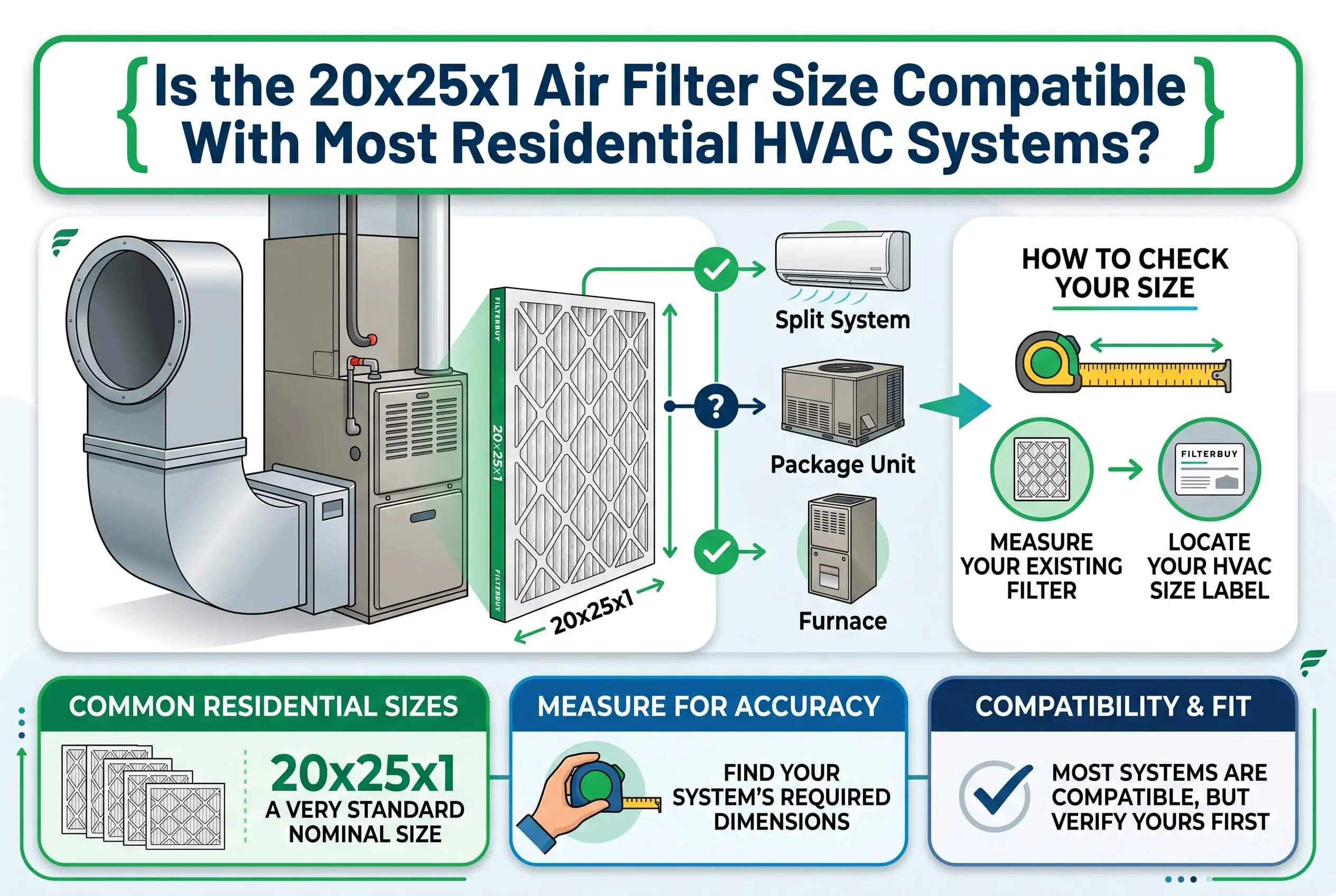
The 20x25x1 is one of the most common residential HVAC filter sizes in the U.S., used in central forced-air furnaces, split-system air handlers, heat pump units, and return-air grilles. The number is a nominal ordering dimension — not a physical measurement. The actual filter frame runs approximately 19.5 x 24.5 x 0.75 inches, intentionally undersized so it seats cleanly in the slot.
To order correctly: pull the existing filter and read the label on the frame. That printed size is what you order by. Measuring the frame with a tape measure produces the wrong number and the wrong filter.
For most residential systems, a MERV 8 to MERV 11 filter in this size strikes the right balance between fine-particle capture and normal airflow. Replace every 60 to 90 days in a standard household, every 30 to 45 days if you have pets or allergy sufferers at home, and every 6 to 12 months in low-occupancy properties.
Top Takeaways
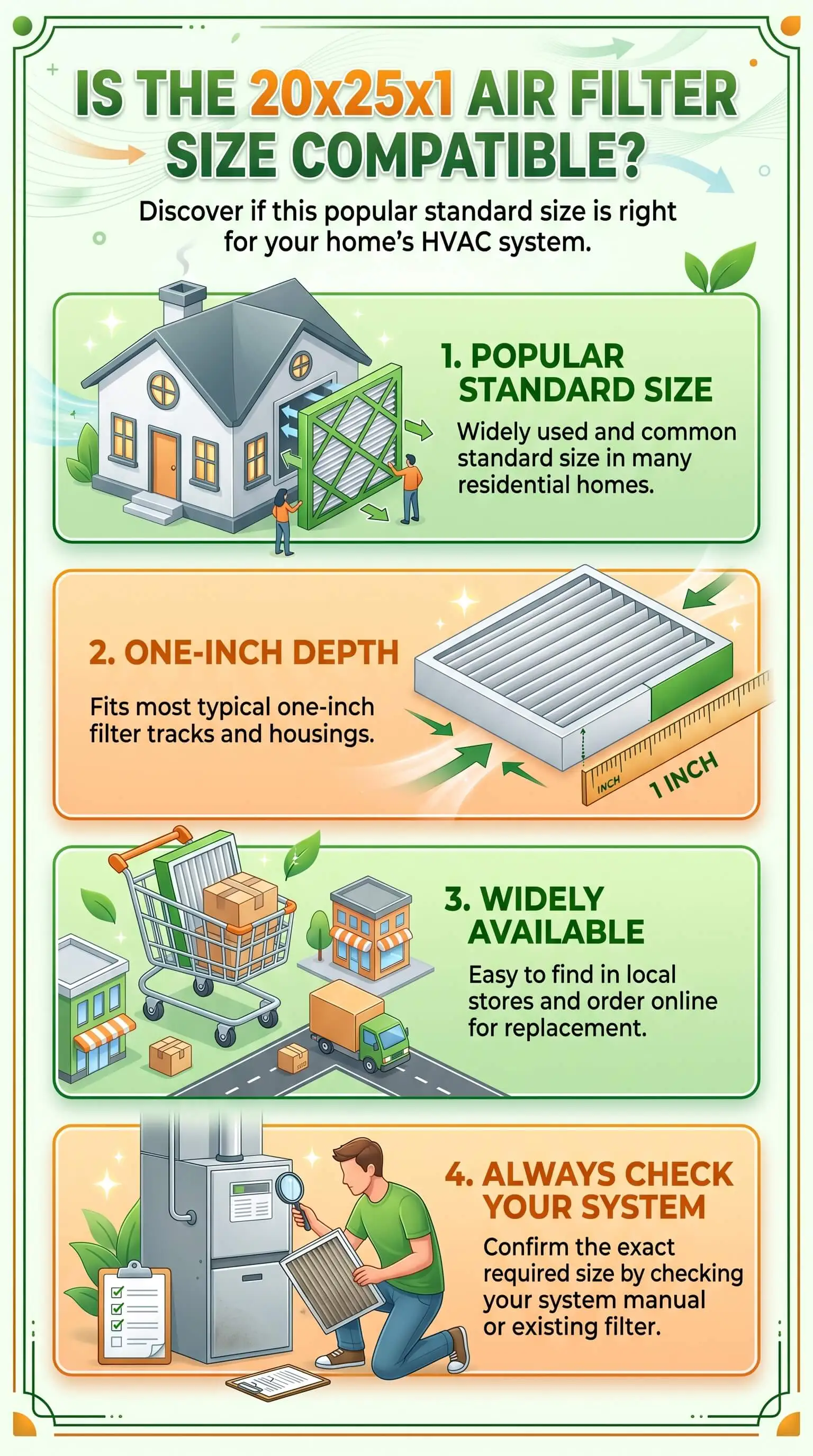
The 20x25x1 is one of the most common nominal filter sizes in U.S. residential HVAC systems, compatible with a wide range of central furnaces, split-system air handlers, heat pump units, and return-air grilles.
The nominal size (20x25x1) is an ordering label, not a physical measurement. The actual frame typically measures 19.5 x 24.5 x 0.75 inches. Order by the label on the frame — not by what the tape measure shows.
If the existing filter's label is unreadable, measure the slot opening and round each number up to the nearest whole inch to find the correct nominal size.
For most residential systems, MERV 8 through MERV 11 delivers the best balance of fine-particle capture and normal airflow. MERV 13 requires a manual check before use in any one-inch slot.
Standard households should replace a 20x25x1 filter every 60 to 90 days. Homes with pets or allergy sufferers need a 30-to-45-day schedule. Low-occupancy properties can stretch to six to twelve months.
A clogged one-inch filter makes the blower motor work harder on every cycle, raising energy costs and stressing both the heat exchanger and the evaporator coil.
Don't rely on the filter's color to decide when to change it. MERV 10 and 11 media loads up with particles too fine to see long before the filter looks spent. Your household's schedule is the reliable guide.
Which HVAC Systems Accept the 20x25x1 Filter Size?
This nominal size fits a wide range of residential HVAC equipment, but the filter slot location changes depending on your system type. Know what you're working with before you order.
Central Forced-Air Furnaces
Most residential gas and electric furnaces house the filter in a slot built directly into the furnace cabinet on the return-air side, upstream from the blower motor and heat exchanger. Single-stage and two-stage units alike typically accept one-inch media. The 20x25x1 is among the most common nominal sizes for this slot — and the most frequent application we see at scale.
Split-System Air Handlers
Air handlers that pair with outdoor condensing units or heat pump compressors place the evaporator coil and blower in an indoor cabinet. The filter slot usually sits on the return-air side of the unit and accepts standard one-inch nominal sizes. The 20x25x1 fits a large share of residential air handler configurations.
Heat Pump Systems With Return-Air Grilles
In many heat pump installations, the filter isn't in the equipment cabinet at all. It lives in a return-air grille mounted in a hallway ceiling or wall. The grille opening sets the filter size, and the 20x25x1 is a standard match for many of those residential configurations.
Packaged HVAC Systems
Packaged units — where the full heating and cooling system lives in a single outdoor or rooftop cabinet — include a return-air filter section that accepts standard nominal sizes, including discount air filters in the common 20x25x1 size.
Before ordering, pull the filter currently in your system and read the label on the frame. That printed size is the one to order. If the label is gone or unreadable, measure the slot opening and round each number up to the nearest whole inch. Learning what an air filter actually captures in a forced-air system will also help you choose the right MERV rating in the next section.
How to Measure Your Filter Slot and Understand Nominal vs. Actual Size
This is where most ordering errors start.
A 20x25x1 filter is not 20 inches by 25 inches by 1 inch. The nominal size is an ordering label — not a physical measurement of the frame. The actual dimensions typically run 19.5 inches by 24.5 inches by 0.75 to 0.875 inches. Manufacturers build that fractional reduction deliberately: a filter cut to its exact nominal dimension would bind in the slot or refuse to insert cleanly. The slight undercut is what lets it seat properly while the media spans the full opening.
Why the Tape Measure Creates Problems
Measure your current filter frame, get 19.5 by 24.5 inches, and type that into a search bar. You've just ordered a 19x24x1 — a different nominal size, a different product. The result is a filter that won't fit the slot cleanly, or seats loose enough to let unfiltered air find the gaps around the edges. When air bypasses the media, it carries dust, pollen, and pet dander straight into the system and through the supply ducts. The filter is still sitting there doing nothing.
Three Steps to Lock In the Right Size
Read the existing filter label first. The nominal size is printed on the cardboard or plastic frame of whatever is in the slot right now. That printed number is what you order. If it says 20x25x1, order a 20x25x1.
Measure the slot if the label is gone. Measure the interior of the filter slot or return-air grille opening — width, height, and depth. Write it down.
Round up to the nearest whole inch. A slot that measures 19.5 by 24.5 by 0.75 inches takes 20x25x1. Always round up. Never order by the raw number off the tape.
Ordering tip: If your tape measure shows 19.5 × 24.5 inches, you need a 20x25x1 — not a 19x24x1. The nominal label wins every time.
Filterbuy stocks every MERV rating in this nominal size. Shop the full 20x25x1 filter selection at Filterbuy to match your system's airflow and filtration requirements.
Choosing the Right MERV Rating for Your 20x25x1 Filter
MERV — Minimum Efficiency Reporting Value — measures how well a filter captures particles of varying sizes. For residential one-inch filters in the 20x25x1 slot, the working range runs from MERV 8 through MERV 13. Higher ratings pull smaller particles out of the air, but they also push back against airflow. That trade-off determines which rating actually works in your system.
MERV 8 — Best for standard homes with no pets. Captures dust, pollen, and mold spores larger than 3 microns. Minimal airflow restriction. Good baseline for most systems.
MERV 10 — Best for homes with light pet dander or moderate dust. Captures everything above plus finer dust and lint in the 1–3 micron range. Low airflow impact. A solid everyday upgrade.
MERV 11 — Best for pet households and allergy sufferers. Captures everything above plus fine particles and auto emissions. Moderate airflow impact. Our most popular rating at Filterbuy.
MERV 13 — Best for high IAQ priority and health-sensitive occupants. Captures everything above plus bacteria, smoke particles, and virus carriers. Higher airflow resistance — verify your system's spec before ordering.
After manufacturing filters for over a decade, what we consistently see is MERV 11 performing well across the widest range of household conditions. It traps the fine particles behind allergy and asthma flare-ups without generating the static pressure that MERV 13 can introduce in systems built around lower-restriction one-inch media.
A Note on MERV 13 in Residential One-Inch Slots
MERV 13 captures bacteria, smoke particles, and the droplet nuclei that carry airborne viruses. That level of filtration comes with denser fiber structure and higher airflow resistance. Residential blower motors sized for standard one-inch media may not pull adequate airflow through a MERV 13 filter under all operating conditions. When airflow drops, the consequences are concrete: rising energy bills, and in more serious cases an iced evaporator coil in summer or an overheating heat exchanger in a gas furnace. Check the owner's manual. The manufacturer's stated maximum MERV rating is a hard ceiling, not a preference.
How Often Should You Replace a 20x25x1 Air Filter?
The answer isn't on the calendar. It's in your air.
A one-inch filter carries less media volume than a four- or five-inch format, so it reaches capacity faster. Here's where your household likely lands:
Standard home, no pets, no respiratory conditions: every 60 to 90 days.
One dog or cat in the home: every 45 to 60 days.
Multiple pets, or someone in the home with allergies or asthma: every 30 to 45 days.
Vacation home or property that sits mostly empty: every 6 to 12 months.
What a Clogged Filter Actually Does to Your System
When the pleats fill with dust, dander, and debris, the blower motor works harder to move the same volume of air. That extra load raises energy consumption and puts stress on the heat exchanger in gas furnaces. In split-system air handlers, reduced airflow drops the evaporator coil surface temperature below the dew point. Ice forms, airflow drops further, and eventually the system shuts down on a low-pressure safety switch. One overdue filter change can take the whole system offline.
Why You Can't Trust How the Filter Looks
A MERV 11 filter doing its job accumulates most of its load from particles in the one-to-three micron range — matter your eyes can't detect without a microscope. That filter can look gray but serviceable at three weeks while already restricting airflow enough to measurably cut system efficiency. Your household's schedule is the reliable guide, not the filter's color.
Common Mistakes to Avoid When Ordering a 20x25x1 HVAC Home Air Filter
Ordering by the measured dimension instead of the nominal size. The filter frame physically measures around 19.5 by 24.5 inches. The correct order is 20x25x1. The tape-measured number produces a mis-sized filter that won't seat cleanly or leaves gaps that let unfiltered air through.
Choosing a MERV rating the system can't handle. A MERV 13 filter in a system designed around MERV 8 media restricts airflow, raises static pressure across the blower, and strains both the motor and the heat exchanger. Check the owner's manual before going above MERV 11 in a one-inch slot.
Installing the filter backward. The arrow on every pleated filter frame points in the direction of airflow — toward the blower motor. Install it facing the wrong way and you reduce filtration efficiency and risk damage to the media structure. Arrow toward the blower, every time.
Buying a fiberglass panel filter and expecting real particle protection. Fiberglass filters in this size typically carry MERV 1 to 4. They stop large debris — hair, lint — but most dust, pollen, mold spores, and pet dander pass straight through. A pleated filter at MERV 8 or above does the actual work.
Waiting until the filter looks visibly dirty to change it. MERV 10 and 11 media loads up with matter invisible to the naked eye long before the filter looks full. A filter that appears to have capacity may already be cutting airflow enough to raise your energy costs and strain your equipment. Stick to the schedule that fits your household.
“The ordering mistake we see most consistently is homeowners measuring the physical filter frame and using that number to search for a replacement. A filter that measures 19.5 by 24.5 inches isn't a 19-by-24 — it's a 20-by-25 nominal filter, and placing the actual measured dimension in a search bar produces a different product entirely. That gap between actual and nominal is what keeps the filter seated correctly in the slot. Order by the measured number and you get a filter that either won't insert or leaves edge gaps where unfiltered air bypasses the media entirely. Reading the printed label on the frame takes ten seconds and eliminates the most common return we see.”
7 Essential Resources
Seven sources we rely on to back up what's in this page. All from federal agencies and accredited industry organizations. All verified live.
1. EPA Introduction to Indoor Air Quality: What's in the Air Your Family Breathes
The EPA's indoor air quality resource lays out what's actually circulating through a typical home — combustion byproducts, biological contaminants like dust mites and mold spores, and fine particle pollution from building materials and daily activity. If you want to understand what your 20x25x1 filter is working against on every pass through the system, start here.
Source: https://www.epa.gov/indoor-air-quality-iaq/introduction-indoor-air-quality
2. U.S. Department of Energy Heating and Cooling Resource: Where Home Energy Goes
Space heating and cooling consume more energy in the average American home than any other single end use. The DOE's Energy Saver resource covers system types, efficiency principles, and the connection between maintenance habits and monthly operating costs. A clogged 20x25x1 filter makes every heating and cooling hour more expensive.
Source: https://www.energy.gov/energysaver/heating-and-cooling
3. ENERGY STAR HVAC Maintenance: The Filter Is the First Line of System Protection
ENERGY STAR flags dirty filters as a leading driver of forced-air system inefficiency and early equipment failure. Their guidance is direct: check the filter monthly, replace it when dirty, and never let it go beyond three months. That interval matters even more for a one-inch format like the 20x25x1, which reaches capacity faster than thicker media.
Source: https://www.energystar.gov/products/ask-the-experts/how-keep-your-hvac-system-working-efficiently
4. CDC Asthma Control Guidance: How Indoor Air Triggers Affect Respiratory Health
The CDC's asthma control resource names the specific indoor allergens that trigger and worsen symptoms in sensitive occupants: dust mites, pet dander, mold spores, cockroach debris. A properly maintained MERV 11 filter in a 20x25x1 slot captures all four from the recirculating air stream on every system cycle. For households managing asthma, that consistency matters.
Source: https://www.cdc.gov/asthma/control/index.html
5. NADCA Homeowner Guides: What Every Homeowner Should Know Before Hiring an HVAC Cleaner
The National Air Duct Cleaners Association publishes practical guidance on HVAC system maintenance and cleaning for homeowners. Their resources explain how debris builds up on mechanical components over time, how duct cleaning differs from filter maintenance, and what a professional cleaning actually involves. A clean 20x25x1 filter is the first line of defense — it keeps debris from reaching the air handler and ductwork in the first place.
Source: https://nadca.com/homeowners/homeowner-guides-and-tips-about-air-duct-cleaning
6. American Lung Association: How HVAC Filters and Air Cleaners Protect Lung Health
The American Lung Association's air cleaning guidance covers HVAC filtration and portable air cleaners together, with direct MERV recommendations for residential systems. Where system specs allow it, they recommend MERV 13 or above for the finest particle capture. For systems that can't run MERV 13 in a one-inch slot, MERV 11 is the meaningful step up.
Source: https://www.lung.org/clean-air/indoor-air/protecting-from-air-pollution/air-cleaning
7. DOE Consumer Guide to Home Heating and Cooling: System Types, Maintenance, and Efficiency Ratings
The DOE's consumer guide walks through every major residential HVAC system type — furnaces, heat pumps, split-system air conditioners, packaged units — and the maintenance practices that keep each one running at rated capacity. Across all of them, the consistent thread is the same: every forced-air system depends on unrestricted airflow through the filter to deliver the heating and cooling it's designed for.
Source: https://www.energy.gov/energysaver/consumer-guide-home-heating-and-cooling-fact-sheet
3 Supporting Statistics
Nearly Half of Home Energy Bills Trace Directly to Heating and Cooling
Nearly half of the energy used in a typical U.S. home goes to heating and cooling. A clogged 20x25x1 filter pushes that number higher on every cycle — the blower motor works against greater resistance and draws more power to move the same volume of conditioned air. Of all the maintenance actions a homeowner controls, keeping the filter current, along with regular AC servicing, is among the most direct levers on a monthly energy bill.
Source: https://www.energystar.gov/saveathome/heating-cooling
Indoor Air Can Carry Pollutant Levels Two to Five Times Higher Than Outdoor Air
EPA research on human exposure to air pollutants found indoor concentrations of some pollutants running two to five times higher than outdoor levels — and in certain conditions, more than 100 times higher. Americans spend roughly 90 percent of their time indoors. The air moving through a residential HVAC system on every cycle isn't background noise; it's the air your household is actually breathing, all day. A 20x25x1 filter rated MERV 8 or above intercepts that recirculating air on every pass through the system.
Source: https://www.epa.gov/iaq-schools/why-indoor-air-quality-important-schools
HVAC Is the Single Largest Energy End-Use in the Residential Building Sector
Heating, ventilation, and air conditioning represent the largest single category of energy consumption in the residential building sector — accounting for more than a third of total building energy use in the U.S. That share isn't fixed. A 20x25x1 filter working against restricted airflow pulls the system's energy draw above where it should be operating. Staying current on filter replacement holds that consumption where your system was designed to run.
Final Thoughts and Opinion
The 20x25x1 is widely available because it fits a large share of the forced-air HVAC systems built in American homes over the past 40 years. That availability is genuinely useful. It can also breed overconfidence.
Widespread availability suggests the hard work is already done. It isn't. The printed label and the tape-measured frame give you two different numbers, and the wrong one generates a return order. The MERV decision takes more than a quick search: a MERV 13 filter in a one-inch slot may look like an upgrade but perform like a liability if your system's blower can't pull adequate airflow through the denser media.
From where we sit in manufacturing, the most protected households we see are the ones where someone spent three minutes confirming the label, checking the owner's manual, and scheduling the next replacement. That's not complicated. It's just consistent — and consistent is what good indoor air actually requires.
Frequently Asked Questions
Q: Is the 20x25x1 a standard residential filter size?
A: Yes. The 20x25x1 is one of the most widely manufactured and stocked filter sizes in the United States. It fits a large portion of the residential forced-air systems installed over the past several decades, including gas furnaces, electric furnaces, split-system air handlers, heat pump air handlers, and return-air grilles. If you have a forced-air system in a standard residential home, there's a strong chance this is already your size.
Q: What is the actual physical size of a nominal 20x25x1 filter?
A: The physical frame on a 20x25x1 filter typically measures 19.5 inches wide by 24.5 inches tall by 0.75 to 0.875 inches thick. Manufacturers build that fractional undercut in so the filter seats cleanly without binding. The nominal size — 20x25x1 — is what you order by. Not the measurement off the frame.
Q: Which MERV rating should I choose for a 20x25x1 filter?
A: The right choice depends on what's in your household:
MERV 8: Standard homes, no pets, no allergy or asthma concerns.
MERV 10: Light pet dander or moderate ambient dust.
MERV 11: One or more pets, or someone in the home with allergies or asthma.
MERV 13: High indoor air quality priority or health-sensitive occupants. Check the system's owner's manual for the maximum supported MERV rating before ordering.
Q: How often should I replace my 20x25x1 air filter?
A: Replacement frequency depends on your household. Standard guidelines:
No pets, no respiratory sensitivities: every 60 to 90 days.
One pet: every 45 to 60 days.
Multiple pets or allergy/asthma sufferers: every 30 to 45 days.
Low-occupancy or vacation homes: every 6 to 12 months.
The 20x25x1 one-inch format holds less media volume than a four- or five-inch filter, so it fills faster. Replace on schedule — not based on how the filter looks.
Q: Can I use a 20x25x1 filter in a 20x25x2 slot?
A: No. A one-inch filter doesn't fill a two-inch slot correctly, and the resulting gap at the back of the slot lets unfiltered air bypass the media. A 20x25x2 slot takes a 20x25x2 filter. Filter depth is not interchangeable across nominal thicknesses.
Q: Will a higher MERV rating damage my HVAC system?
A: Not immediately, but a MERV rating above your system's designed airflow capacity creates real consequences over time. The blower motor works against higher resistance, energy consumption climbs, and in gas furnaces the restricted airflow over the heat exchanger can cause overheating. In split-system air conditioners, low airflow across the evaporator coil causes ice formation. Check the owner's manual for your specific unit before installing anything above MERV 11 in a one-inch slot.
Q: Where is the filter slot located on a residential HVAC system?
A: It depends on what type of system you have:
Central gas or electric furnace: built into the furnace cabinet on the return-air side, accessed by removing a panel or sliding door.
Split-system air handler: on the return-air side of the air handler cabinet, usually near where the return duct connects.
Return-air grilles: in many heat pump installations, the filter sits behind a grille mounted in a hallway ceiling or wall — not in the equipment cabinet at all.
If you're not sure, trace the return-air ductwork back from the main living area toward the air-handling equipment. The filter sits at the transition point between the duct system and the equipment.
Q: Can a visual inspection tell me when to change my filter?
A: Only when the filter is already well past due. A filter packed gray with visible debris is clearly overdue. The more common problem runs the other direction: a MERV 10 or 11 filter accumulates most of its particle load from matter in the one-to-three micron range — matter you can't see without magnification. That filter can look serviceable while already restricting airflow enough to reduce efficiency and raise your energy draw. Replace based on your household's schedule, not what the filter looks like.
Find the Right 20x25x1 Filter for Your System
Filterbuy manufactures 20x25x1 filters across the full MERV range — MERV 8 through MERV 13 — and ships them directly from U.S. facilities. Check your owner's manual for your system's MERV ceiling first, then compare your options.
View the full 20x25x1 air filter selection at Filterbuy to compare MERV ratings, filter media types, and subscription replacement options.