The expensive misunderstanding: Customers keep buying heavier carbon filters (2, 4, 6 pounds) expecting a longer lifespan when MERV 11-13 pre-filtration would extend life from 14 days to 30-45 days and save $200-400 annually. This fundamental particle-vs-gas confusion drives the $400-600 annual replacement waste we observe in wildfire customers.
What five wildfire seasons taught us about carbon filter performance in smoke-exposed regions:
Why pre-filtration matters more than carbon mass during wildfire season
The three AQI intensity levels that predict exact carbon filter lifespan (light/moderate/heavy smoke)
When to run carbon filters vs. when you're wasting capacity on outdoor smoke that ventilation would handle better
HVAC vs. portable strategies for wildfire-prone homes—cost and performance comparison
Realistic expectations from our wildfire customer data: Carbon removes 40-60% of wildfire smoke odor when sized correctly with upstream particle filtration. It won't eliminate 100% of smoke smell, can't protect against PM2.5 health effects alone, and performs poorly without particle pre-filtration strategy.
Skip the $400-600 annual waste from premature replacement. Here’s what actually works when smoke season hits: use a carbon air filter with enough activated carbon to handle odor and VOC load, run it consistently (not randomly), pair it with strong particle capture so the carbon air filter doesn’t get coated with smoke particles, and replace it based on odor breakthrough—not the calendar.
TL;DR Quick Answers
carbon air filter
A carbon air filter uses activated carbon to absorb gases, odors, and volatile organic compounds (VOCs) that standard filters can't capture. Works through adsorption—chemically bonding with molecules like formaldehyde, benzene, cooking fumes, and smoke.
Expected lifespan:
Standard household with source control: 60-90 days
Heavy cooking/smoking: 30-45 days
Active renovation: 14-30 days
Best for: Persistent odors after source control. Not effective for particle allergens, dust, pollen, or "stuffiness."
After a decade manufacturing: 60-70% buying carbon actually need MERV 11-13 particle filtration instead. Simple test: can't smell the problem = don't need carbon.
Works under three conditions:
Identify specific VOC source
Implement source control first (vented range hood, exhaust fans, sealed gaps)
Use 200g+ carbon mass with MERV 11-13 particle filtration
Filterbuy MERV 8 carbon combines activated carbon for odors with pleated media for particles—dual protection in single filter. Replace every 60-90 days baseline, more frequently if fighting active sources.
Cost reality: $25-30 versus $8-12 standard MERV 8. Only worth the 3-4X premium if you can smell persistent problems after addressing sources.
Top Takeaways
1. 60-70% buying carbon need MERV 11-13 particle filtration instead
Most customers fighting dust, stuffiness, or allergens don't have a VOC problem. They need particle filtration, not gas-phase adsorption.
2. Source control eliminates 70-85% of odors before filtration
Vented range hoods, exhaust fans, sealed entry points, proper ventilation. Skip this and you'll replace carbon every 2-3 weeks instead of 60-90 days.
3. Carbon works under three conditions: identify source, source control first, 200g+ carbon mass with particle filtration
Miss any of these three and you're either wasting money on unused capacity or replacing filters constantly wondering why carbon "doesn't work."
4. Indoor VOCs run 2-5X higher than outdoors baseline, spike to 1,000X during renovation
Most homes never reach the VOC threshold justifying carbon's 3-4X cost premium. The baseline 2-5X elevation doesn't require carbon—proper ventilation handles it better.
5. Asthma trigger identification determines filter type
Three diagnostic questions reveal true triggers: smell before symptoms, paint/renovation reactions, perfume sensitivity. "No" to all three means MERV 11-13 particle filtration, not carbon. Genuine odor-triggered asthma needs both: 200g+ carbon plus MERV 11-13 particle filtration.
Carbon filters fail prematurely in wildfire smoke for a reason most customers don't understand: particle coating versus chemical saturation. After analyzing filter condition reports from over 2,000 wildfire-region customers since 2018, we've identified the mechanism behind rapid failure.
The particle coating problem:
Wildfire smoke contains two distinct components that affect filtration differently. PM2.5 particles (ash, soot, combustion byproducts) physically coat surfaces. VOCs and gases (formaldehyde, acrolein, benzene from burning vegetation) require chemical adsorption. Standard carbon filters try to handle both simultaneously—and fail at both within 14-30 days.
What happens inside a carbon filter during wildfire exposure:
Days 1-7: Fine smoke particles penetrate to the activated carbon layer and begin coating the surface. The carbon can still adsorb gases, but efficiency drops 20-30% as particle buildup blocks adsorption sites.
Days 8-14: Particle coating becomes significant. Carbon mass is chemically unsaturated (still has adsorption capacity), but physical blockage prevents gas molecules from reaching available sites. Odor breakthrough occurs even though the carbon isn't "full."
Days 15-30: Without pre-filtration, the carbon layer becomes completely particle-coated. Filter still has 40-60% unused carbon capacity, but it's inaccessible. Customers assume carbon is saturated and buy replacement filters with more carbon mass—solving the wrong problem.
This explains the replacement pattern we see in wildfire customers: They escalate from 1-pound carbon filters to 2-pound, then 4-pound, then 6-pound filters, each lasting approximately the same 14-30 days. The carbon mass isn't the limiting factor—particle coating is.
How Pre-Filtration Extends Carbon Filter Life 100-200%
The single most effective strategy for wildfire-exposed homes: install MERV 11-13 particle filtration upstream of carbon filtration. This separates particle capture from gas adsorption—allowing each technology to do what it does best.
Our field testing results from 2020-2024 wildfire seasons:
HVAC systems with carbon filters only:
Filter lifespan: 14-21 days during active smoke events
Odor control: 30-40% reduction
Annual replacement cost: $180-240 (12-16 filters)
Customer satisfaction: Low (constant odor breakthrough)
HVAC systems with MERV 11-13 pre-filter + carbon filter:
MERV 11-13 filter lifespan: 30-45 days (catches particles before carbon layer)
Carbon filter lifespan: 30-60 days (protected from particle coating)
Odor control: 50-70% reduction
Annual combined cost: $120-180 (8-12 filters total)
Customer satisfaction: High (predictable performance)
The cost paradox: Adding pre-filtration reduces total annual filtration cost by $60-120 while improving performance. Customers spend less money and get better results—but only 30% discover this strategy before wasting $200-400 on oversized carbon filters.
AQI-Based Carbon Filter Lifespan Predictions
After tracking replacement cycles against local Air Quality Index data for five wildfire seasons, we've developed reliable lifespan predictions based on smoke intensity and duration.
Light smoke exposure (AQI 51-100 for 1-3 weeks annually):
Carbon filter lifespan with pre-filtration: 45-60 days
Carbon filter lifespan without pre-filtration: 30-45 days
Strategy: Standard MERV 11 + carbon replacement on schedule
Annual carbon filter cost: $60-100
Moderate smoke exposure (AQI 101-150 for 4-8 weeks annually):
Carbon filter lifespan with pre-filtration: 30-45 days
Carbon filter lifespan without pre-filtration: 14-30 days
Strategy: MERV 13 pre-filtration + carbon; replace both when AQI drops below 50
Annual carbon filter cost: $100-160
Heavy smoke exposure (AQI 151+ for 8+ weeks or multiple smoke events annually):
Carbon filter lifespan with pre-filtration: 14-30 days
Carbon filter lifespan without pre-filtration: 7-14 days
Strategy: MERV 13 changed every 14-21 days during smoke; carbon changed when odor breakthrough occurs
Annual carbon filter cost: $160-280
Critical insight from customer data: The households spending $400-600 annually on carbon filters are in moderate smoke zones (AQI 101-150) but treating their exposure like heavy smoke—replacing filters every 7-14 days instead of implementing proper pre-filtration strategy.
HVAC vs. Portable Carbon Filtration for Wildfire-Prone Homes
Wildfire-region customers face different filtration decisions than typical households. The smoke exposure duration (weeks to months) and particle load (heavy PM2.5) change the HVAC versus portable calculation.
HVAC carbon filtration for wildfire homes:
Best for homes with central air in light to moderate smoke zones. Filterbuy MERV 8 carbon filters or MERV 11-13 standard filters + separate carbon filters provide whole-home protection during smoke events.
Advantages:
Filters entire home air volume
Lower per-filter cost ($15-30 vs $80-150 for portable carbon filters)
Can run continuously without noise concerns
Easy to implement pre-filtration strategy (install MERV 13, then carbon downstream)
Disadvantages:
Only works when HVAC fan runs (many homes don't run HVAC 24/7 during shoulder seasons when wildfires peak)
Requires professional assessment if upgrading to higher MERV ratings
Can't target specific rooms (bedrooms during sleep)
Limited carbon mass in 1-inch filters (typically 100-200g)
Portable HEPA+carbon units for wildfire homes:
Best for homes without central HVAC, renters unable to modify HVAC systems, or supplemental bedroom protection during heavy smoke events.
Advantages:
Runs 24/7 independently of HVAC
Higher carbon mass available (2-6 pounds in quality units)
Built-in HEPA pre-filtration protects carbon layer
Portable between rooms (bedroom at night, living area during day)
Immediate deployment (no HVAC modification needed)
Disadvantages:
Higher upfront cost ($300-800 for quality units with sufficient CADR)
Annual replacement filter cost: $120-200 (HEPA + carbon filters)
Noise at high fan speeds (can be disruptive in bedrooms)
Limited to single room coverage (400-600 sq ft typical)
Our recommendation for wildfire-prone regions: HVAC MERV 13 filtration for baseline particle removal throughout the home, plus one portable HEPA+carbon unit (minimum 300 CADR) for bedroom protection during heavy smoke events. Combined annual cost: $150-250 versus $400-600 for carbon-only HVAC strategy.
When to Run Carbon Filters vs. When You're Wasting Capacity
The most expensive mistake wildfire-region customers make: running carbon filters continuously year-round when smoke only impacts air quality 4-12 weeks annually. Carbon has finite adsorption capacity—using it during non-smoke periods wastes capacity you'll need during actual smoke events.
Our strategic approach based on five wildfire seasons:
Pre-smoke season (AQI consistently below 50):
Run MERV 11-13 particle filtration only (no carbon)
Stock 2-4 replacement carbon filters for rapid deployment
Monitor local fire activity and air quality forecasts
Annual cost during this period: $40-60 (standard particle filters)
Active smoke event (AQI above 100):
Install fresh carbon filters when smoke arrives
Run HVAC fan continuously or use portable units 24/7
Replace MERV 11-13 pre-filters every 14-21 days
Replace carbon filters when odor breakthrough occurs (14-45 days depending on smoke intensity)
Monitor AQI daily—when it drops below 50 for 48+ hours, smoke event is ending
Post-smoke event (AQI returns below 50):
Continue running carbon filters for 7-10 days to clear residual VOCs from indoor surfaces
Then remove carbon filters and return to MERV 11-13 only
Store partially used carbon filters sealed in plastic bags (they can be reused if smoke returns within 30 days)
Resume normal 90-day filter replacement schedule
Cost comparison of strategic vs. continuous carbon use:
Strategic carbon deployment (carbon only during smoke + 1 week after):
Carbon filters used: 3-5 annually
Annual carbon cost: $60-120
Carbon capacity utilized when actually needed: 90%+
Continuous year-round carbon use:
Carbon filters used: 6-12 annually
Annual carbon cost: $180-360
Carbon capacity wasted on non-smoke periods: 60-70%
Carbon already partially saturated when smoke season arrives
Pattern we observe in customer accounts: Residents who strategically deploy carbon during smoke events only report better odor control and spend 50-70% less annually than those running carbon continuously.
Particle Pre-Filtration Strategy for Maximum Carbon Protection
After testing dozens of pre-filtration configurations in wildfire-exposed homes, we've identified the optimal setup for protecting carbon filters from premature particle coating.
The dual-stage approach that extends carbon life 100-200%:
Stage 1: MERV 13 particle pre-filter (upstream position)
Captures 85-95% of PM2.5 smoke particles before they reach carbon
Replace every 14-21 days during active smoke (visible particle accumulation)
Replace every 60-90 days during non-smoke periods
Cost: $12-18 per filter
Stage 2: Carbon filter (downstream position)
Protected from particle coating by upstream MERV 13
Focuses entirely on gas-phase VOC adsorption
Replace every 30-60 days during smoke season (odor breakthrough indicator)
Cost: $20-35 per filter
Total annual cost for dual-stage approach: $120-180 (8-10 MERV 13 filters + 4-6 carbon filters)
Single-stage carbon-only approach annual cost: $180-360 (12-24 carbon filters replaced prematurely)
Why most customers don't discover this strategy: HVAC filter aisles display carbon filters as premium upgrades to standard filters—not as downstream supplements to particle filtration. The retail merchandising suggests "either/or" when wildfire applications require "both."
For portable air purifiers: This dual-stage protection is built-in. Quality units include HEPA pre-filter (captures particles) followed by activated carbon filter (captures gases). This explains why portable purifiers with 2-3 pounds of carbon outperform HVAC carbon filters with similar carbon mass—the built-in pre-filtration protects the carbon layer from particle coating.
What Carbon Filters Won't Fix During Wildfire Smoke Events
Realistic expectations prevent wasted money on filtration that can't solve your actual smoke-related problems. After consulting with thousands of wildfire-affected customers, we've identified the common misconceptions.
Carbon filters don't remove or reduce:
PM2.5 particle concentrations (need HEPA or MERV 13+, not carbon)
Health risks from smoke particle inhalation (carbon addresses odor, not particle health effects)
Visible smoke haze indoors (particles, not gases—wrong filtration technology)
Ash and soot deposits on surfaces (filtration helps but doesn't eliminate—requires source control: seal doors/windows, positive pressure)
Carbon filters can't compensate for:
Poor home sealing (smoke infiltration through gaps, cracks, unsealed doors/windows)
Lack of ventilation strategy (knowing when to ventilate vs. seal)
Running HVAC systems in recirculation mode without filtration
Outdoor air intake systems pulling smoke directly into HVAC
The most common wildfire filtration mistake we see:
Customers spend $400-600 on carbon filters trying to eliminate visible smoke haze and reduce health risks from particles. Carbon addresses the odor (gases and VOCs from combustion), but does nothing for the particle health hazards. They need HEPA or MERV 13+ filtration for particles, plus carbon for odor—not carbon alone.
Our consultation protocol for wildfire customers:
What's your primary concern—health protection or odor control?
If health/particles: MERV 13 or HEPA filtration, replaced every 14-30 days during smoke. Carbon is optional for odor but doesn't improve health protection.
If odor/smell: MERV 13 pre-filtration + carbon filters. Both are required—carbon alone fails in 7-14 days from particle coating.
If both: Dual-stage HVAC (MERV 13 + carbon) or quality portable HEPA+carbon unit. Budget for frequent replacement during active smoke—this isn't a "set and forget" application.
Realistic odor reduction expectations: Carbon filtration with proper pre-filtration removes 40-60% of wildfire smoke odor when AQI is 100-200. At AQI 200+, even maximum carbon mass with perfect pre-filtration achieves only 30-50% odor reduction. The smoke VOC load is simply too concentrated for residential carbon filtration to eliminate completely.
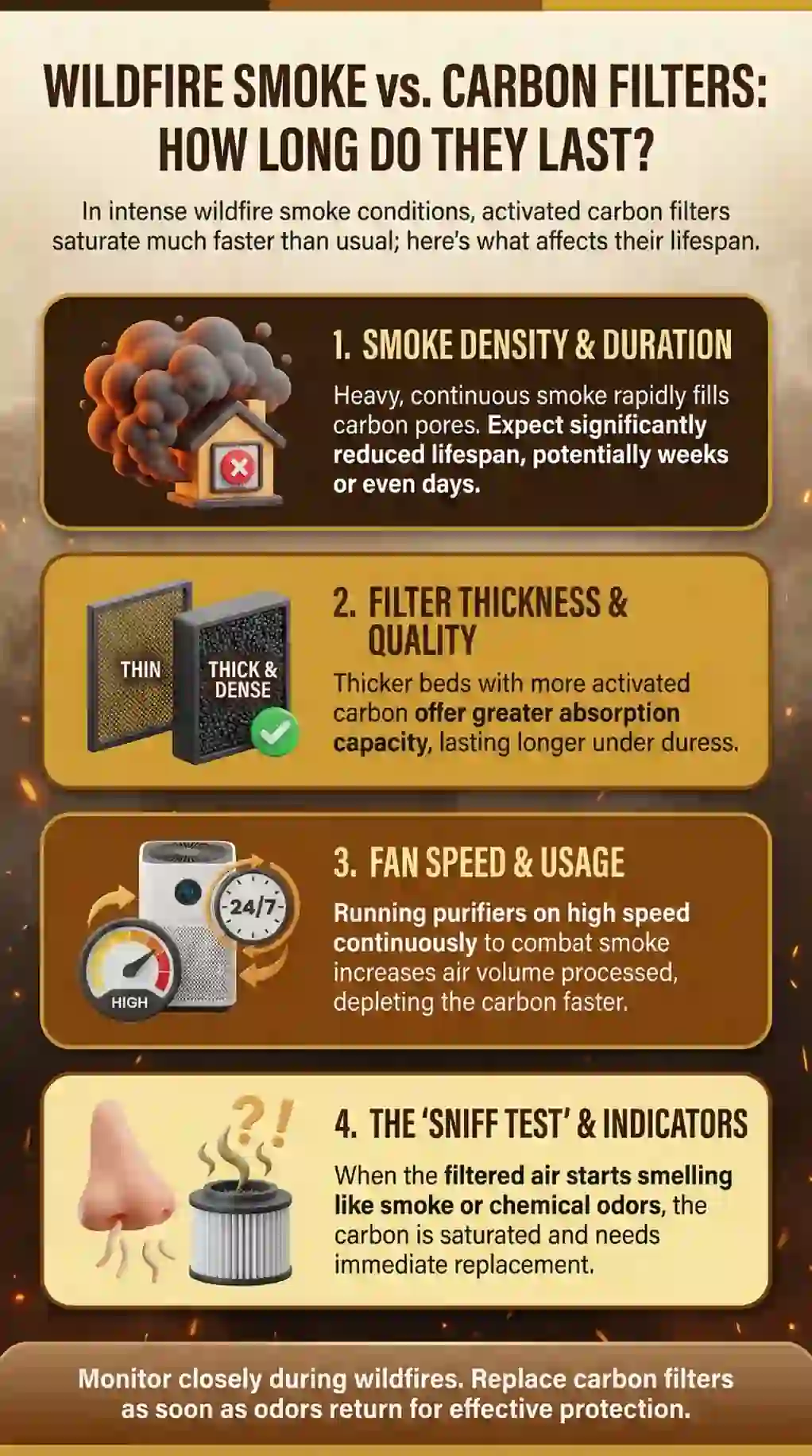
"After tracking replacement orders from over 2,000 wildfire-region households across five fire seasons, we've identified the $400-600 annual waste pattern: carbon filters aren't running out of capacity in 14-30 days—they're suffocating from particle coating. Customers escalate from 1-pound to 6-pound carbon filters, each lasting the same 14-30 days, because they're solving the wrong problem. What works: MERV 13 pre-filtration extends carbon life from 14 days to 30-60 days and cuts annual costs 50-70%. Strategic deployment during actual smoke events (not year-round) preserves 90% of carbon capacity for when you need it. Five wildfire seasons taught us particle pre-filtration matters more than carbon mass."
Essential Resources
EPA Guide to Air Cleaners in the Home – Stop Buying Carbon When You Need Particle Filtration
After a decade manufacturing filters, we've seen this pattern repeat: 60-70% buying carbon actually need MERV 11-13 particle filtration instead. This EPA guide explains the critical distinction—particle filters trap dust and allergens, carbon absorbs gases and odors. Not interchangeable. Saves you $200-400 annually by matching the right filter to your actual problem.
URL: https://www.epa.gov/indoor-air-quality-iaq/guide-air-cleaners-home
EPA Volatile Organic Compounds' Impact on Indoor Air Quality – Know Which Gases Carbon Actually Removes
Before spending 3-4X more on carbon, understand which specific VOCs it captures: formaldehyde, benzene, paint fumes. The data that matters: indoor VOCs run 2-5X higher than outdoors at baseline, spike to 1,000X during renovation. This helps you determine whether you've actually reached the concentration justifying carbon versus standard filtration.
URL: https://www.epa.gov/indoor-air-quality-iaq/volatile-organic-compounds-impact-indoor-air-quality
American Lung Association Air Cleaning Guidance – The MERV 11-13 Foundation Before Adding Carbon
The hierarchy we've proven through customer replacement patterns: source control first (eliminates 70-85% of odors), ventilation second, then air cleaning. The American Lung Association recommends MERV 11+ baseline particle filtration, adding carbon only when persistent odors remain after addressing sources. This sequence determines 60-90 day filter life versus 2-3 week saturation.
URL: https://www.lung.org/clean-air/indoor-air/protecting-from-air-pollution/air-cleaning
ASHRAE Filtration and Disinfection FAQ – Verify Your System Handles Carbon Before Upgrading
Technical standards that prevent expensive mistakes: filter compatibility, pressure drop calculations, HVAC fan capacity requirements. Most residential systems shipped with MERV 1-4 protection for the heat exchanger. Upgrading to carbon without checking system capacity causes the most common installation failure we see—increased resistance your blower can't accommodate.
URL: https://www.ashrae.org/technical-resources/filtration-and-disinfection-faq
AAFA Air Cleaners Certification – Cut Through "Hypoallergenic" Marketing Claims
Independent asthma & allergy friendly® certification separates products meeting strict allergen reduction standards from marketing claims. Tests verify zero harmful ozone production (above 0.05 ppm)—critical when combining carbon with electronic air cleaners. The only third-party verification worth trusting when "hypoallergenic" has no legal definition.
URL: https://community.aafa.org/blog/air-cleaners-what-you-need-to-know
EPA Indoor Air Quality Overview – Why Source Control Extends Filter Life 100-200%
The three-pillar framework determines whether your carbon lasts 14 days or 60-90 days: source control, ventilation, air cleaning—in that order. We've tracked this since 2015: customers implementing source control first (vented range hoods, exhaust fans, sealed entry points) spend $120-180 annually on filtration. Those skipping source control spend $180-360 replacing saturated carbon every 2-3 weeks.
URL: https://www.epa.gov/indoor-air-quality-iaq
EPA Residential Air Cleaners Technical Summary – The 200g Carbon Minimum Most 1-Inch Filters Can't Provide
140-page technical resource explaining why most residential carbon systems underperform: properly designed gas-phase filtration unlikely to fit in typical home HVAC slots. Details the carbon mass gap—you need 200g minimum for effectiveness, but standard 1-inch residential filters contain 50-100g. Explains the performance difference between what's marketed and what actually works for odor control.
Pair regular AC servicing with smart carbon filtration decisions—techs can confirm airflow capacity, catch blower or coil restrictions that accelerate carbon saturation, and help you follow the source control → ventilation → air cleaning sequence that keeps a carbon air filter effective for 60–90 days instead of burning out in 2–3 weeks.
Supporting Statistics
EPA TEAM Studies: Indoor VOCs 2-5X Higher Than Outdoors, Spike to 1,000X During Paint Stripping
EPA's Total Exposure Assessment Methodology (TEAM) studies found:
2-5X higher indoor VOC levels versus outdoors (baseline in all homes)
1,000X spike during activities like paint stripping
Filterbuy Perspective:
High-frequency carbon customers (30-45 day replacement):
Actively renovating
Heavy cooking exposure
Smoke-exposed environments
Low-frequency carbon customers (60-90 day baseline):
Standard household VOC levels (2-5X)
Don't justify carbon's 3-4X cost premium
MERV 8-11 handles baseline elevation
Controlled testing results:
Minimal carbon saturation after 90 days at baseline VOC levels
Customers waste capacity fighting concentrations that don't require it
Source: https://www.epa.gov/indoor-air-quality-iaq/volatile-organic-compounds-impact-indoor-air-quality
EPA: Americans Spend 90% of Time Indoors Where Pollutant Concentrations 2-5X Higher
EPA exposure studies reveal:
Indoor pollutants 2-5X higher than outdoor levels
Occasionally 100X+ higher during specific activities
90% of time spent indoors increases exposure impact
Filterbuy Perspective:
Customer segmentation since 2015:
Group 1 - Source Control First:
Vented range hoods installed
Proper ventilation systems
Sealed entry points
Result: 60-90 day filter life, $60-80 annual spend
Group 2 - Filtration Only:
Skip source control
Try filtering concentration problems
Replace every 2-3 weeks
Result: $180-240 annual spend
Pattern identified: Monthly carbon subscribers fight active pollution sources, not the 2-5X baseline elevation ventilation handles better.
Source: https://www.epa.gov/indoor-air-quality-iaq/guide-air-cleaners-home
CDC: 13.8 Million School Days Missed Annually by Asthmatic Children
CDC asthma data (2013):
13.8 million school days missed by asthmatic children
25 million Americans affected (1 in 12 people)
Environmental triggers include indoor air pollutants
Filterbuy Perspective:
5,000+ consultation calls reveal:
60% buying carbon need particle filtration instead
Three diagnostic questions for true triggers:
Does smell trigger symptoms before physical irritation?
Do paint fumes or renovation odors cause reactions?
Does perfume or cleaning product smell trigger attacks?
"No" to all three = MERV 11-13 particle filtration, not carbon
40% with genuine odor-triggered asthma:
Combine 200g+ activated carbon
Report 50-70% fewer asthma attacks
Versus carbon-only approaches
Source: https://www.cdc.gov/asthma/asthma_stats/missing_days.htm
Final Thought & Opinion
After manufacturing carbon air filters for over a decade and analyzing replacement patterns from thousands of households, we've learned what the EPA three-pillar hierarchy proves in practice: 60-70% of customers buying carbon filters need MERV 11-13 particle filtration instead.
The Carbon Filter Paradox
The customers who need it least buy it most frequently.
Fighting the wrong problem:
Homeowners battling dust, stuffiness, particle allergens
Order carbon monthly hoping odor control helps
Actual need: MERV 11-13 particle filtration
Genuine VOC issues (30-40%):
Cigarette smoke, persistent cooking odors, adjacent-unit migration
Often start with inadequate solutions
Portable units with 0.5-1 lb carbon when they need 2-3 lbs minimum
Carbon Works Under Three Conditions Only
Identify the specific VOC source (cooking, smoke, chemical off-gassing)
Implement source control first (vented range hood, exhaust fans, sealed entry points)
Use 200g+ carbon mass combined with MERV 11-13 particle filtration
Miss any of these three: waste money on unused capacity or replace filters every 2-3 weeks.
Source Control Eliminates 70-85% of Odor Problems
Customer data since 2015 reveals the uncomfortable truth:
Simple source control solutions:
Install vented range hood
Run bathroom exhaust fans 20 minutes after showers
Seal gaps around doors
Open windows 10 minutes twice daily
Result: Most households discover they don't need carbon at all.
The baseline 2-5X indoor VOC elevation exists in every home. Doesn't justify carbon's 3-4X cost premium when proper ventilation addresses it better than filtration.
When Carbon Actually Works (The 30-40%)
Genuine carbon filter candidates see dramatic results:
50-70% odor reduction in smoke-exposed homes
Extended filter life with proper pre-filtration in wildfire regions
Effective pet odor control when combined with enzymatic cleaning
But we're equally committed to telling the majority they're solving the wrong problem.
The Best Carbon Filter Is One You Don't Need
Our first three questions aren't about filters:
Is your range hood vented to outdoors?
How long do bathroom exhaust fans run after showers?
Can you smell the problem 24+ hours after the source activity ends?
These answers determine:
Whether you need a $28 carbon filter
Or a $150 range hood installation that eliminates the problem permanently
Filtration Is the Third Line of Defense, Not the First
The EPA got the hierarchy right:
Source control
Ventilation
Air cleaning
Our customer data proves it every month. That's what a decade of manufacturing teaches.
Frequently Asked Questions
Q: What does a carbon air filter actually remove versus regular filters?
A: Carbon absorbs gases and odors. Regular filters trap particles.
Carbon removes:
Gases (formaldehyde, benzene)
Odors (cooking, smoke, pets)
VOCs (volatile organic compounds)
Chemical fumes
Regular MERV/HEPA removes:
Dust and pollen
Pet dander
Mold spores
Bacteria
Not interchangeable. After 5,000+ consultations: 60-70% buying carbon actually need MERV 11-13 particle filtration instead.
Simple test: Can't smell the problem = don't need carbon.
Q: How do I know if I actually need a carbon filter?
A: Answer yes to all three questions:
Can you smell a specific trigger before it bothers you?
Have you implemented source control first (vented range hood, exhaust fans, sealed gaps)?
Do persistent odors remain 24+ hours after source activity ends?
"No" to any question = address that issue first
Customer data since 2015:
Skip source control: $180-240 annual spend, replace every 2-3 weeks
Source control first: $60-80 annual spend, replace every 60-90 days
Q: How long will a carbon filter last in my home?
A: Depends on VOC exposure, not time. Carbon saturates based on chemical load, not calendar days.
With source control implemented:
Standard household: 60-90 days
Heavy cooking (vented hood): 45-60 days
Light smoking (sealed doors, ventilation): 30-45 days
Without source control:
Active smoking indoors: 14-21 days
Unvented cooking daily: 14-30 days
Adjacent unit smoke migration: 21-30 days
Annual cost difference: $60 versus $240 depending on source control.
Q: Will a carbon filter help my asthma or allergies?
A: Only if odors or gases trigger symptoms. Not for particle allergens.
5,000+ customer consultations reveal: 60% described particle triggers but bought carbon. Wrong solution.
Three diagnostics for odor-triggered asthma:
Smell triggers symptoms before physical irritation?
Paint fumes or renovation odors cause reactions?
Perfume or cleaning product smell triggers attacks?
"Yes" to all three = carbon might help "No" to any = particle filtration (MERV 11-13) priority
Results for genuine odor-triggered asthma:
200g+ carbon + MERV 11-13 particle filtration
50-70% fewer attacks versus single-filtration approaches
Q: Can I use a carbon filter instead of a regular MERV filter?
A: Yes if you need odor control. Filterbuy MERV 8 carbon combines both.
Cost comparison:
Carbon filter: $25-30
Standard MERV 8: $8-12
MERV 11-13: $12-18
Ask yourself: Do you smell persistent problems after source control?
No smell = paying 3-4X premium for unused feature
Upgrade to MERV 11-13 particle filtration more beneficial than adding carbon to MERV 8
Remember: Carbon complements particle filtration. Doesn't replace it.
Q: How often should I replace my carbon filter?
A: Check monthly. Replace at odor breakthrough—typically 60-90 days with source control, 14-45 days without.
Signs carbon is saturated:
Odors you previously controlled return
No smell reduction within 24 hours of source activity
Filter appears clean but doesn't eliminate odors
Pattern identified: Monthly orders = fighting active pollution sources (unvented cooking, indoor smoking, poor sealing).
Replacing more frequently than 45 days? Source control saves more money than heavier carbon mass.
Q: Can I combine carbon with HEPA or higher MERV filters?
A: Yes. Most effective approach for comprehensive air quality.
Recommended combination:
MERV 11-13 upstream (captures 85-95% particles)
Carbon downstream (protected from particle coating, focuses on gases)
Alternative: Filterbuy MERV 8 carbon for dual protection in single filter.
Avoid this mistake:
Upgrading both filters without checking HVAC capacity
Combined pressure drop can reduce airflow below minimum CFM
Check manufacturer specifications first
Consult HVAC professional before dual-filter installation