TL;DR Quick Answers
24x24x1 air filter
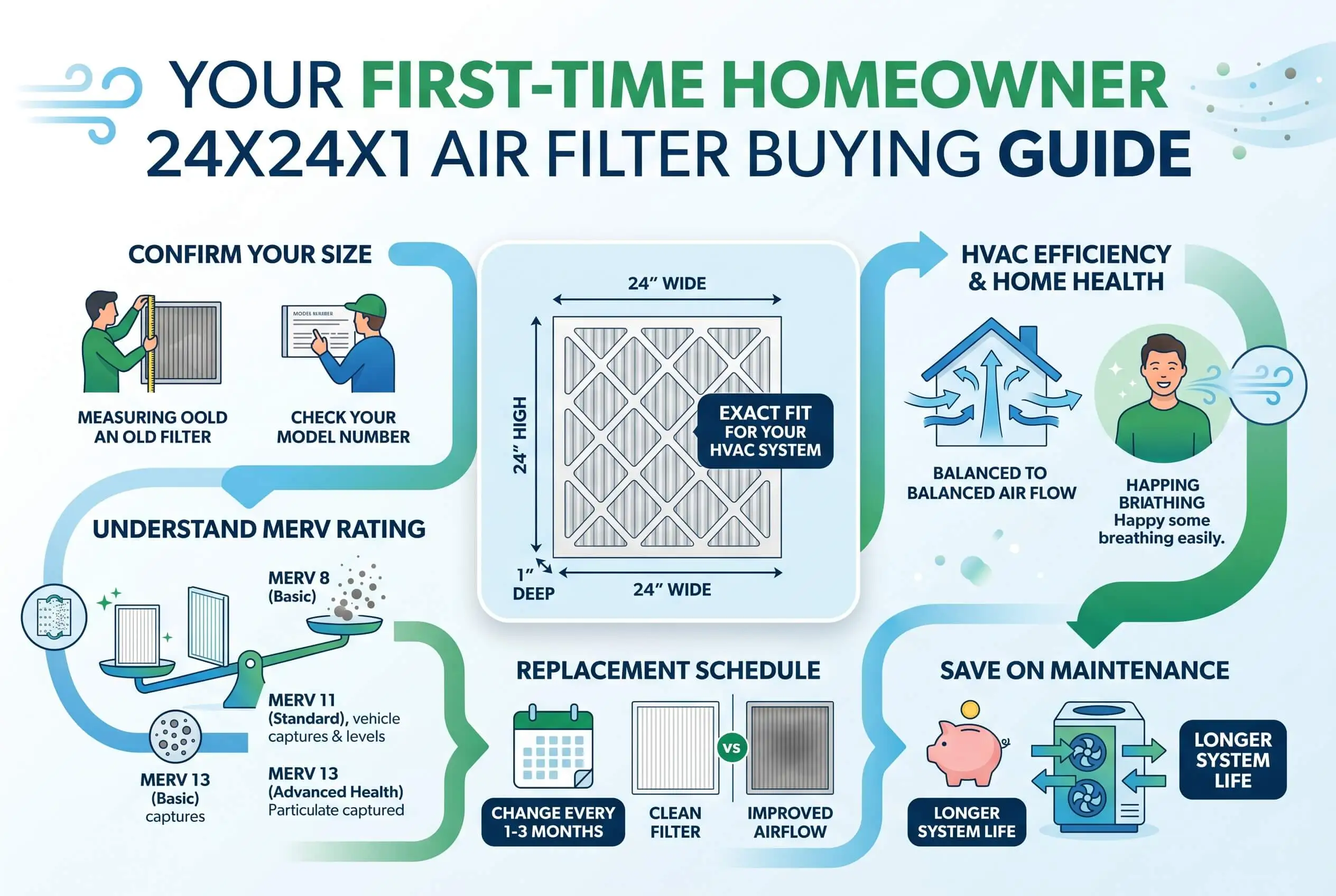
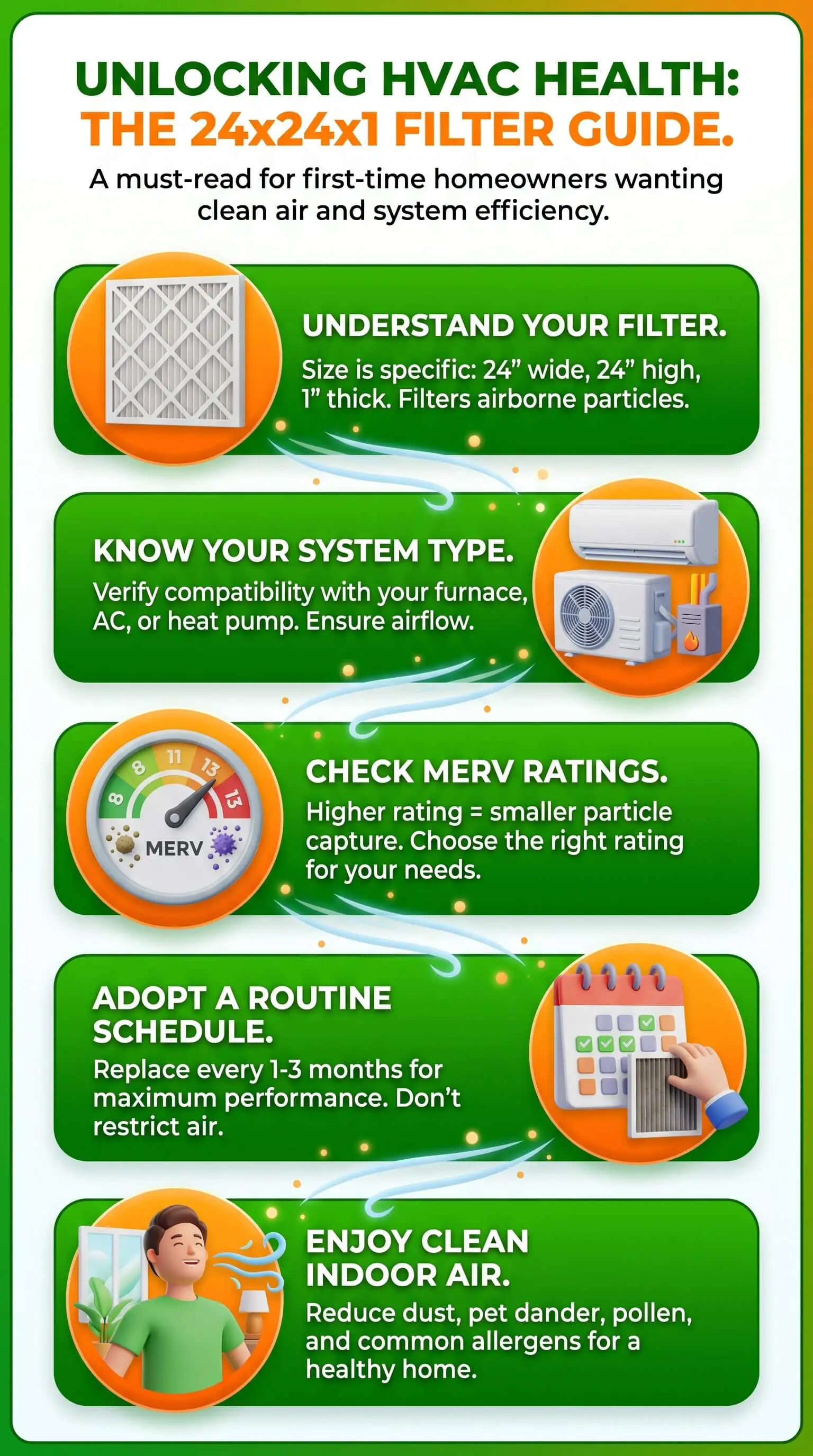
A 24x24x1 air filter is a common residential HVAC filter that actually measures about 23.38 x 23.38 x 0.75 inches. The 24x24x1 on the label is the nominal size used for shopping. It fits most central return grilles in homes built since the early 1990s.
Actual size: 23.38" x 23.38" x 0.75" (order by the printed nominal size, not the tape reading)
Where it goes: Central return grilles, ceiling or wall mount, and many vertical air handler slots
MERV options: MERV 8 (general use), MERV 11 (pets or mild allergies), MERV 13 (severe allergies, asthma, or wildfire smoke)
Replacement cadence: Every 90 days baseline; 60 days with pets; 30 to 45 days with severe allergies or wildfire smoke
Install direction: Airflow arrow points toward the blower, away from the room
Top Takeaways
The printed size on the box (24x24x1) is the nominal size. The actual filter measures roughly 23.38 x 23.38 x 0.75 inches. Order by the printed size, not the tape measurement.
MERV 8, 11, and 13 cover the practical residential range. Match the rating to household variables like pets, allergies, and system age, not the marketing on the box.
Replace every 90 days as a baseline. Sooner with pets, smokers, or active allergy seasons.
The airflow arrow points toward the blower. A backwards filter reduces efficiency and lets unfiltered air slip around the edges.
Online multipacks and auto-delivery subscriptions cut per-filter cost by roughly 50 to 70 percent compared to single big-box pickups. [VERIFY pricing range with operations]
Why 24x24x1 Is So Common (and Why That Causes Sizing Mistakes)
This is one of the most widely used residential filter sizes in the country, which is why the chances of a new homeowner running into one are pretty high. Most people find theirs behind a ceiling-mounted return grille in a hallway, or in a wall-mounted return near the thermostat. A smaller subset have a second filter sitting in the air handler closet — worth checking on the first walk-around, because if you only swap one, the unchanged filter keeps choking the system.
The popularity has a downside: sizing confusion. Two filters labeled 24x24x1 by different manufacturers come out to slightly different actual measurements, and the printed size is never the literal one. The standard tolerance puts the actual filter at roughly 23.38 inches square by three-quarters of an inch thick. The extra clearance lets it seat in the housing without binding. During regular AC servicing, checking the printed side panel helps make sure the right replacement filter goes in, supporting cleaner airflow and easier maintenance. Measure your existing filter with a tape, order by the reading, and you’ll get the wrong size every time. Read the printed side panel instead. Order by what’s on the label: 24x24x1.
MERV Ratings, Plus the MPR and FPR Translations
MERV stands for Minimum Efficiency Reporting Value. It’s the industry standard, set by ASHRAE 52.2, the test method that measures how well a filter catches particles between 0.3 and 10 microns. A MERV rating chart helps homeowners compare those performance levels more clearly. The residential and commercial scale runs from 1 to 16. Higher numbers catch smaller particles, with a tradeoff that comes up in the next section.
Two retailers muddy the picture with proprietary ratings of their own. MPR (Microparticle Performance Rating) is 3M’s, printed on Filtrete boxes. FPR (Filter Performance Rating) is Home Depot’s. Both translate roughly to MERV but use different numeric scales, which is why two filters with very different printed ratings can perform almost identically in your system.
Here’s the practical translation when shopping for a 24x24x1 air filter:
MERV 8: catches around 90 percent of larger airborne particles like pollen, dust, and lint. Roughly equivalent to MPR 600 or FPR 5. The right pick for most homes without allergy concerns.
MERV 11: catches around 95 percent and starts to trap finer particles, including pet dander and mold spores. Roughly equivalent to MPR 1000-1200 or FPR 7. Good middle ground for homes with pets or seasonal allergies.
MERV 13: catches around 98 percent and reaches into the range of smoke, bacteria, and viral particles. Equivalent to MPR 1500-1900 or FPR 10. Best for serious allergies, asthma, or anyone wanting hospital-grade air quality.
Treat MPR and FPR as marketing translations of the same underlying science. When comparing across brands, convert everything back to MERV.
How to Match a MERV Rating to Your Home
Higher is not always better, and that’s the part most first-time homeowners don’t expect. The blower in a residential HVAC system is sized for a specific range of resistance. A MERV 13 filter restricts airflow significantly more than a MERV 8. On a newer high-efficiency variable-speed system, the blower compensates. On an older single-stage system, especially one in a home built before 2000 with the original blower, pushing up to MERV 13 can starve the system of airflow, force it to short-cycle, and over time damage the evaporator coil. ENERGY STAR recommends checking the system’s specs before upgrading the filter rating.
A reasonable starting framework:
No pets, no allergies, no asthma in the household: MERV 8 is plenty.
One or two pets, mild seasonal allergies: MERV 11 is the sweet spot.
Severe allergies, asthma, an immunocompromised family member, or wildfire smoke as a regular concern: MERV 13, but only after verifying the system can handle the static pressure.
When unsure, have a tech do a one-time pressure-drop check before committing to the higher MERV. It’s a 15-minute job that prevents the bigger expense of an iced-up coil.
When to Change the Filter
Default cadence on a 24x24x1 is 90 days. Use that as a starting point, then adjust for what’s actually in the air. Pet dander, smoking, ongoing construction, heavy allergy seasons, and wildfire smoke all shorten the useful life of a filter.
A workable schedule:
Baseline household with no pets and no smokers: 90 days
One pet or mild allergies: 60 days
Two or more pets, or a heavy shedder: 45 days
Severe allergies or wildfire smoke a regular concern: 30 to 45 days
Active renovation or new construction in the home: check every two weeks until the dust clears
The cheapest test takes ten seconds. Hold the filter up to a light source. If light can’t pass through the pleats, the filter’s done. ENERGY STAR recommends checking the filter monthly during heavy heating and cooling seasons, even if you don’t change it that often.
Skipping replacements is the single most expensive mistake a new homeowner can make. A clogged filter pushes the blower harder, raises the monthly utility bill, and shortens the working life of the entire system.
Installation and Where to Buy
The airflow arrow printed on the filter frame points toward the blower, away from the room. Install the filter backwards and the pleat structure works against the airflow instead of with it, which reduces efficiency and sometimes lets unfiltered air slip around the edges. Once the filter is seated, check the perimeter for any visible gap. A properly installed filter sits flush with no daylight showing around the frame.
Three places to buy, ranked by what they actually deliver:
Big-box stores. Convenient when the change is overdue and you need a filter today. Per-unit pricing is the highest of the three options, and the in-store MERV selection usually maxes out at MERV 11.
Online specialty retailers. Lower per-unit pricing, broader MERV options, and more made-in-USA choices. Multipacks of six or twelve drop the per-filter cost by roughly 50 to 70 percent compared to single big-box pickups. [VERIFY pricing range with operations]
Subscription services. The same online retailers offer auto-delivery on whatever cadence you set. This is the practical fix for the single most common failure mode in new homes: forgetting to change the filter at all.
“The mistake I see most often in first-home walk-throughs has nothing to do with MERV. People grab a tape measure, get a reading that’s smaller than what’s on the label, and then order by the tape reading. They wedge a slightly oversized filter into the housing, the frame bends, and unfiltered air bypasses the pleats entirely. That defeats the whole point of having a filter in the first place. Read the side panel of the filter you’re replacing and order by what’s printed. That’s the nominal size, and it’s what you want.”
7 Essential Resources
EPA — Guide to Air Cleaners in the Home. The starting point on how filtration fits into indoor air quality at home. https://www.epa.gov/indoor-air-quality-iaq/guide-air-cleaners-home
EPA — Air Cleaners and Air Filters in the Home. The technical follow-up on filter selection and HVAC integration. https://www.epa.gov/indoor-air-quality-iaq/air-cleaners-and-air-filters-home
ENERGY STAR — HVAC Maintenance Checklist. Step-by-step list of what professional maintenance covers, filter replacement included. https://www.energystar.gov/saveathome/heating-cooling/maintenance-checklist
ENERGY STAR — Heat and Cool Efficiently. Practical guidance on inspection cadence and how dirty filters drive up bills. https://www.energystar.gov/saveathome/heating-cooling
U.S. Department of Energy — Maintaining Your Air Conditioner. DOE’s guidance on replacement frequency and why airflow restriction damages the system. https://www.energy.gov/energysaver/air-conditioner-maintenance
CDC — Improving Air Cleanliness Through Filtration. NIOSH guidance on upgrading HVAC filter efficiency. https://www.cdc.gov/niosh/ventilation/prevention/air-cleanliness.html
CDC — Ventilation FAQs. Plain-language reference for the ASHRAE 52.2 standard and how MERV ratings are determined. https://www.cdc.gov/niosh/ventilation/faq/index.html
3 Supporting Statistics
Indoor air pollution ranks among the top five environmental health risks identified by the EPA. With Americans spending around 90 percent of their time indoors, the air pulled through the return grille has a direct effect on long-term health. (EPA)
Roughly half of the energy used in a typical U.S. home goes to heating and cooling. A clogged filter forces the HVAC system to work harder for the same output, and the bill reflects it. (ENERGY STAR)
When airflow drops, dust bypasses the filter and builds up on the evaporator coil. That reduces the coil’s heat-absorbing capacity and can cause early system failure. (U.S. Department of Energy)
Final Thoughts and Opinion
After enough first-home visits, the same pattern shows up. The biggest air filter mistakes have almost nothing to do with MERV. They’re the small ones — trusting the tape-measure reading over the printed size, forgetting to set a calendar reminder for the 90-day swap, installing the filter with the airflow arrow facing the wrong way. A MERV 8 filter changed on schedule beats a MERV 13 filter left in the slot for a year. That’s why home air filters work best when the basics are handled first: the right size, the right direction, and a replacement schedule you can actually stick to. The honest opinion of every tech I’ve worked with: pick a reasonable MERV rating, set up auto-delivery, and put a reminder on the calendar. The rest takes care of itself.
Frequently Asked Questions
What is the actual size of a 24x24x1 air filter?
About 23.38 inches by 23.38 inches by 0.75 inches. The 24x24x1 label is the nominal size — the rounded number used for shopping and inventory. The actual filter runs slightly smaller so it seats in its housing without binding. When ordering, always go by the nominal size on the printed label.
How often should I change a 24x24x1 filter?
Every 90 days as the baseline. Drop to 60 days with pets, 45 days for multiple pets or a heavy shedder, and 30 days during wildfire smoke season or active home construction. ENERGY STAR recommends a monthly inspection during heavy heating and cooling months.
What MERV rating is best for my first home?
MERV 8 is enough for most households without pets or allergies. Pet owners and people with mild allergies benefit from MERV 11. For severe allergies, asthma, or anyone wanting hospital-grade air quality, MERV 13 is the right choice, provided the HVAC blower can handle the higher airflow resistance.
Where is the air filter located in my house?
In most residential systems, behind a return grille on a hallway wall or ceiling, or in a dedicated filter slot on the side of the indoor air handler or furnace cabinet. Some homes have filters in both spots, which is worth checking on the first walk-around.
Is it OK to use a cheaper fiberglass filter?
Basic fiberglass filters cost less but only catch the largest particles. They protect the system from dust buildup but do little for indoor air quality. For furnace filters, that makes pleated options a better everyday upgrade for cleaner airflow. A pleated MERV 8 filter is a meaningful step up at a similar price point and lasts the same 90 days.
What happens if I forget to change the filter?
Airflow drops, the blower works harder, energy bills rise, and dust bypasses the clogged pleats and coats the evaporator coil. Over time, reduced cooling capacity can ice the coil over and force the compressor to overwork. A timely filter change is a fraction of the cost of the service call that follows. [VERIFY repair-cost figure with operations before quoting any dollar amount]
Call to Action
Open the return grille in your home right now. Pull the filter out, hold it up to a light, and check the printed size on the side panel. If it’s a 24x24x1 and you can’t see light through the pleats, today is the right day to order the replacement. For many homes, MERV 8 filters offer a practical balance of airflow, dust capture, and routine HVAC protection. Set a calendar reminder for 90 days out and one decision turns into a routine.