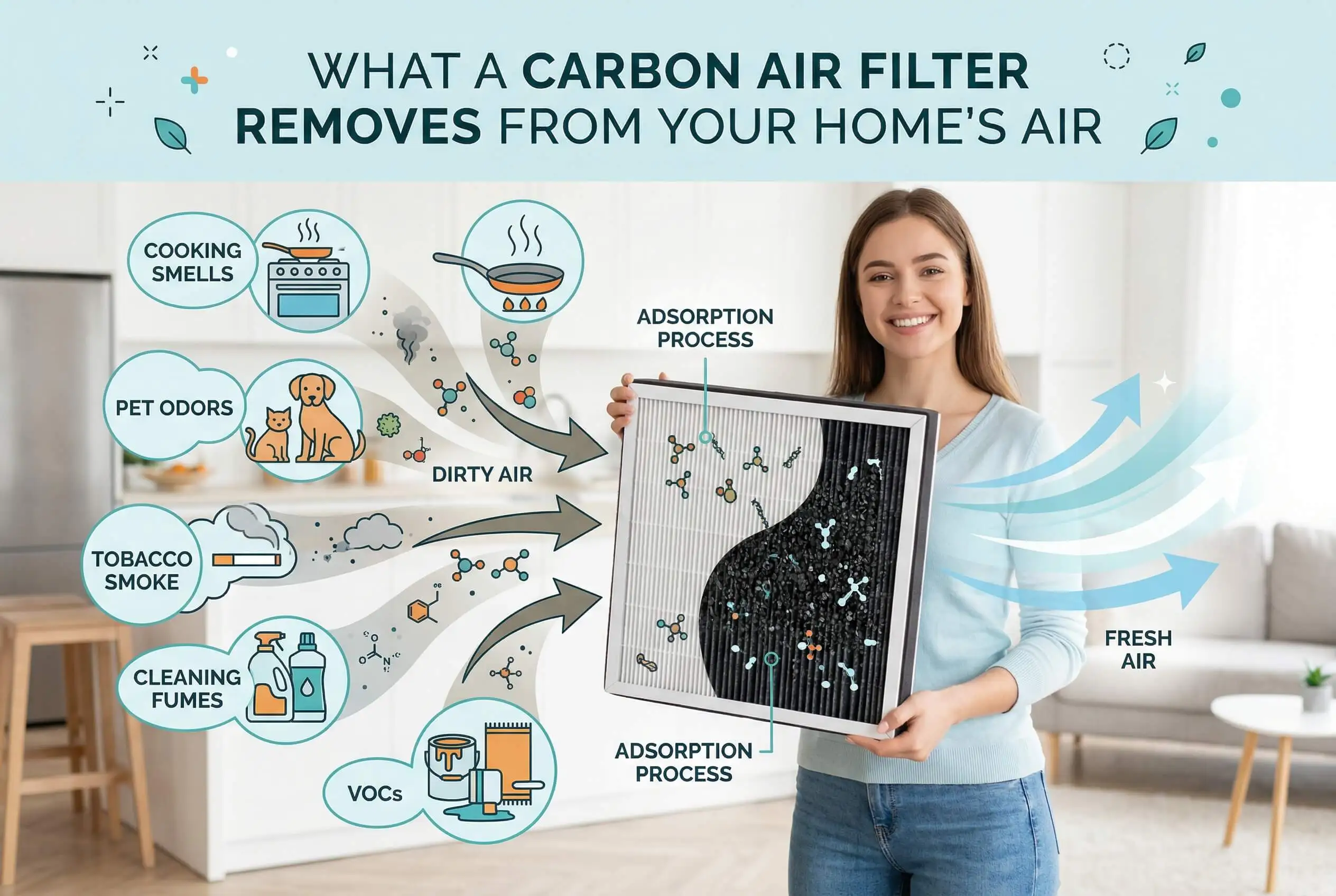
VOCs from paint and cleaning products, pet odor compounds, cigarette smoke, and cooking byproducts all pass straight through fiberglass and low-MERV filters. Carbon captures them through adsorption — bonding pollutants to its porous surface at the molecular level. It's a fundamentally different mechanism, built for a fundamentally different problem.
Here, we break down exactly what carbon filters remove, where they fall short, and how to determine whether your home actually needs one.
TL;DR Quick Answers
carbon filter
A carbon filter removes gas-phase pollutants — VOCs, formaldehyde, cooking odors, pet odor compounds, and chemical fumes — from your home's air through a process called adsorption. Standard particle filters cannot do this. After manufacturing air filters for over a decade, the most consistent pattern we see: homes running a standard filter against a gas-phase problem and wondering why the air never quite feels right. A carbon filter is the solution for odors and invisible chemical pollutants. A particle filter is the solution for dust, pollen, dander, and mold spores. The most complete home air quality strategy uses both.
The short version:
Carbon filters capture gases and odors
Particle filters capture dust, pollen, and dander
Most homes need both
Replace every 60 to 90 days — sooner in high-load households
Appearance does not indicate performance — replace on schedule, not by sight
Top Takeaways
Carbon filters and standard filters solve fundamentally different problems. Particle filters capture dust, pollen, and dander. Carbon filters capture gases, odors, and chemical compounds. These are two different mechanisms for two different categories of pollutant. A complete air quality strategy requires both.
Your indoor air is almost certainly more polluted than the air outside. The EPA confirms indoor pollutant concentrations run two to five times higher than outdoor levels. During painting, floor refinishing, or heavy cleaning product use, VOC concentrations can spike to 1,000 times background outdoor levels. The invisible threat inside your home is nearly always greater than anything happening outside it.
Formaldehyde is in virtually every American home — and only carbon can address it. It off-gasses from:
Furniture and cabinetry
Flooring and adhesives
Building materials and pressed wood products
The EPA formally determined in January 2025 that formaldehyde presents an unreasonable risk to human health through inhalation. A standard particle filter provides zero protection against it.
Replace your carbon filter on schedule — not by appearance. Carbon filters don't look dirty when they're spent. Once adsorption capacity is exhausted, gas-phase pollutants pass straight through. In high-load households, that window can be as short as 30 days. By the time odors return, the filter's capacity is already gone.
The homes that need carbon filtration most are often the last to realize it. The highest-risk household profiles include:
Pet owners
Families in newly renovated homes
Households with attached garages
Homeowners who use cleaning products heavily
Most are running standard particle filters and attributing their air quality problems to something else entirely. Knowing your home's risk profile is the first step toward the right filtration strategy.
How Activated Carbon Actually Works
Most air filters are mechanical — they physically catch particles in a web of fibers. Activated carbon works differently. Its surface is processed to create millions of microscopic pores, giving it an enormous surface area relative to its size. When gaseous pollutants pass through, they bond to that surface in a process called adsorption. The pollutant doesn't pass through. It stays trapped.
This is why carbon filters solve problems that even high-MERV filters can't. A MERV 13 filter is exceptionally good at capturing fine particles — dust, pollen, mold spores, pet dander. But gases and odors are a different class of contaminant entirely. They require a different class of filtration.
The Gases and Odors Carbon Filters Target
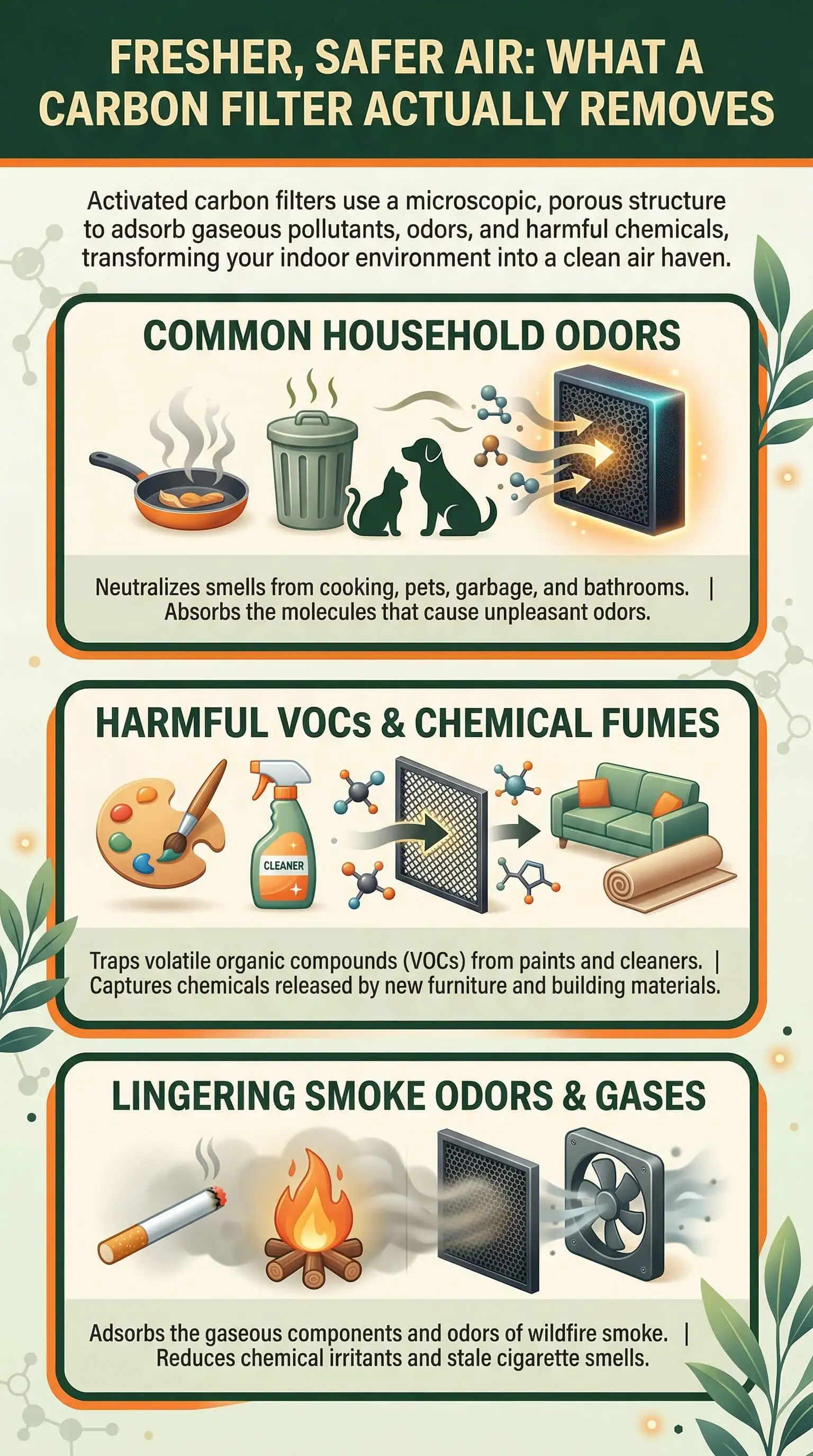
In our experience manufacturing filters for over a decade, the contaminants homeowners notice most aren't the ones they can see — they're the ones they can smell. Carbon filters are designed to address:
Volatile organic compounds (VOCs) — off-gassed from paints, adhesives, new furniture, flooring, and cleaning products
Cooking odors — grease byproducts, smoke, and food compounds that recirculate through the HVAC system
Pet odors — specifically the gaseous compounds that linger long after visible dander is removed
Tobacco and smoke — including wildfire smoke that infiltrates from outdoors
Formaldehyde — a common VOC found in building materials, cabinetry, and household products
Chemical fumes — from hobby materials, solvents, and aerosol products used indoors
These aren't niche concerns. The EPA has consistently identified indoor air as two to five times more polluted than outdoor air — and gaseous pollutants are a significant contributor to that gap.
What Carbon Filters Don't Remove
This is the part most filter marketing glosses over, and it's worth being direct about. Carbon filters are not designed to remove particles. They won't capture dust, pollen, mold spores, or pet dander with any meaningful efficiency on their own.
That's why the most effective filtration approach combines both technologies. In our line, carbon filters are paired with a pleated MERV-rated media layer — so the filter handles particles and gases simultaneously. A standalone carbon filter without a particle filtration layer leaves a significant portion of your home's air quality problem unaddressed.
Carbon filters also have a finite adsorption capacity. Once the pores are saturated, the filter can no longer bond additional pollutants — and in some cases, a fully saturated filter may begin to release previously trapped compounds back into the air. This is one of the most common oversights we see among homeowners: running a carbon filter well past its effective lifespan because the filter still looks clean. With carbon, appearance is not a reliable indicator of performance.
Which Homes Benefit Most From Carbon Filtration
Not every home needs a carbon filter. Based on what we've seen across millions of customer interactions, the households that see the greatest benefit tend to share a few characteristics:
New construction or recent renovation — off-gassing from materials is at its highest in the first one to two years
Homes with pets — particularly multi-pet households where odor compounds accumulate faster
Attached garages — vehicle exhaust and chemical storage fumes migrate into living spaces more readily than most homeowners expect
Homes with smokers — or homes recently purchased from previous smokers
High-VOC environments — households that use cleaning products heavily, have hobbies involving adhesives or solvents, or work from home with chemical-intensive materials
If your home checks more than one of these boxes, a carbon-equipped filter isn't an upgrade — it's a necessity.
How to Know When Your Carbon Filter Needs Replacing
Because carbon filters don't show visible loading the way particle filters do, replacement timing is the most underestimated maintenance issue in this category. As a general guideline:
Standard carbon filters in average households: every 60 to 90 days
Higher-load environments (pets, smoke, VOC-heavy use): every 30 to 60 days
Any time odors return that the filter previously controlled — this is the clearest real-world signal that adsorption capacity is exhausted
Staying on schedule matters more with carbon than with almost any other filter type.
"Most homeowners assume that if their filter is catching dust, their air is clean. What we've learned after manufacturing filters for over a decade is that particle filtration and gas filtration are two completely separate battles — and most homes are only fighting one of them. The contaminants that affect how your air smells, how it feels, and how it impacts your family's long-term health are often the ones you can't see and your standard filter was never designed to catch. A carbon filter isn't an add-on for people with special concerns. For homes with pets, recent renovations, attached garages, or any consistent source of chemical off-gassing, it's a fundamental part of a complete filtration strategy. The other thing we tell customers consistently: don't wait until you can smell the problem again to change it. By the time odors return, the filter's capacity is already gone."
Essential Resources
Don't take your indoor air for granted. After manufacturing air filters for over a decade and serving more than two million households, we've learned that the homeowners who make the best filtration decisions are the ones who understand the full picture — not just the product. These seven authoritative resources give you exactly that. Read them, and you'll know more about what's actually floating through your home's air than most people ever will.
The Invisible Gas Problem Most Homeowners Don't Know They Have U.S. Environmental Protection Agency — Volatile Organic Compounds' Impact on Indoor Air Quality In our experience, VOCs are the most misunderstood air quality threat in the home — because you can't see them and your standard filter wasn't built to catch them. The EPA confirms that VOC concentrations indoors run two to five times higher than outdoors, driven by everyday products already sitting in your home. This is the resource that makes the invisible visible. https://www.epa.gov/indoor-air-quality-iaq/volatile-organic-compounds-impact-indoor-air-quality
Know the Difference Between Filtering Particles and Filtering Gases — Before You Buy U.S. Environmental Protection Agency — Guide to Air Cleaners in the Home One of the most common mistakes we see is homeowners upgrading to a higher MERV rating when what they actually need is gas-phase filtration. This EPA consumer guide explains the difference clearly — and it's the same distinction that drives how we engineer our Odor Eliminator filters to handle both particle capture and activated carbon adsorption in one filter. https://www.epa.gov/indoor-air-quality-iaq/guide-air-cleaners-home
What's Really Living in Your Home's Air Right Now U.S. Environmental Protection Agency — Introduction to Indoor Air Quality Before you can protect your family, you need to understand what you're protecting them from. This foundational EPA overview covers the full spectrum of indoor pollutants — particles, gases, and biological contaminants — and why no single strategy eliminates them all. We recommend it to every homeowner who asks us where to start. https://www.epa.gov/indoor-air-quality-iaq/introduction-indoor-air-quality
Why Formaldehyde May Be the Most Dangerous Thing in Your Home Right Now U.S. Environmental Protection Agency — Facts About Formaldehyde Formaldehyde off-gasses from the furniture, cabinetry, flooring, and building materials found in virtually every American home — and the EPA has determined it presents unreasonable risk to human health under chronic exposure. It's also one of the primary gas-phase pollutants that activated carbon is specifically designed to intercept. This resource tells you exactly what you're dealing with. https://www.epa.gov/formaldehyde/facts-about-formaldehyde
The Filter Maintenance Habit That Keeps Your Family's Air Protected Year-Round U.S. Environmental Protection Agency — Care for Your Air: A Guide to Indoor Air Quality Serving over two million households has taught us one consistent truth: the homeowners with the best indoor air quality aren't the ones with the most expensive equipment — they're the ones who stay on schedule. This EPA guide covers the filter change habits, ventilation strategies, and source control practices that keep your entire air quality system working the way it should. https://www.epa.gov/indoor-air-quality-iaq/care-your-air-guide-indoor-air-quality
What Lung Health Experts Say Every Home Needs From Its Air Filter American Lung Association — Air Cleaning The American Lung Association's air cleaning guidance is one of the most credible third-party voices in the industry — and they specifically recommend activated carbon filtration for homes with odors, chemical sensitivities, or vulnerable family members. When your filter manufacturer and the nation's leading lung health organization are pointing in the same direction, that's a signal worth paying attention to. https://www.lung.org/clean-air/indoor-air/protecting-from-air-pollution/air-cleaning
Why Pet Owners Need a Filter That Goes Beyond Standard Particle Capture American Lung Association — Pet Dander Nearly 62% of U.S. households have pets — and after working with millions of pet-owning customers, we know their air quality challenges are different. Pet allergens and odor compounds behave differently than dust or pollen: they stay airborne longer, they penetrate deeper into living spaces, and they require gas-phase filtration to fully address. Our Odor Eliminator filter was built with exactly these households in mind. The Lung Association explains the science behind why. https://www.lung.org/clean-air/indoor-air/indoor-air-pollutants/pet-dander
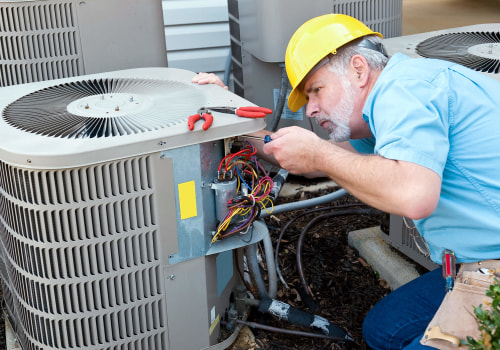
These resources reinforce the importance of regular AC servicing by showing that healthier indoor air depends not only on the right filter, but also on a well-maintained system that supports proper airflow, ventilation, and year-round pollutant control.
Supporting Statistics
After manufacturing air filters for over a decade and serving more than two million households, we've seen these numbers play out in real homes. They describe conditions inside the houses of the families we serve every day.
90% of the average American's time is spent indoors — where pollutant concentrations are often 2 to 5 times higher than outdoors.
What surprises most homeowners: the air quality problem they worry about outside is almost always less severe than what's happening inside their own home. Here's what that means in practice:
Indoor air is consistently more polluted than outdoor air
Your family's greatest exposure happens at home — during dinner, during sleep, during every hour spent inside
The wrong filter — or one running past its effective life — leaves your family exposed to a problem that doesn't take a day off
Source: U.S. Environmental Protection Agency — Indoor Air Quality https://www.epa.gov/report-environment/indoor-air-quality
During and immediately after certain indoor activities, VOC concentrations can spike to 1,000 times background outdoor levels.
We hear this reaction often: "I just painted one room — how bad could it be?" The EPA's research answers that question in a way that stops most homeowners cold. The highest-risk VOC exposure events aren't slow and chronic. They're sudden and situational:
Painting and floor refinishing
Adhesive and sealant application
Heavy cleaning product use
Hobby materials and solvents
A standard particle filter provides zero protection during these peak exposure windows. Activated carbon is the only residential filtration mechanism that addresses gas-phase pollutants at all.
Source: U.S. Environmental Protection Agency — Volatile Organic Compounds' Impact on Indoor Air Quality https://www.epa.gov/indoor-air-quality-iaq/volatile-organic-compounds-impact-indoor-air-quality
In January 2025, the EPA formally determined that formaldehyde presents an unreasonable risk of injury to human health.
Formaldehyde is the contaminant that generates the most surprise among the homeowners we work with. People expect it in industrial settings. They don't expect to find it in:
New kitchen cabinets and furniture
Recently installed flooring
Pressed wood products used throughout the home
Paints, adhesives, and building materials
The EPA's finalized risk evaluation under the Toxic Substances Control Act confirms what we've understood from the manufacturing side for years. Formaldehyde is a pervasive inhalation-route threat in residential environments. Activated carbon is what intercepts it before it recirculates through your HVAC system and back into your family's breathing air.
Source: U.S. Environmental Protection Agency — Risk Evaluation for Formaldehyde https://www.epa.gov/assessing-and-managing-chemicals-under-tsca/risk-evaluation-formaldehyde
Nearly 62% of U.S. households have pets — and pet allergens linger in the air longer than almost any other common indoor pollutant.
Pet-owning households are one of the largest and most consistent customer segments we serve. The pattern is nearly universal. Their air quality challenge has two distinct layers:
The visible layer — dander, hair, and debris that standard particle filters address
The invisible layer — gaseous odor compounds that accumulate in ductwork, embed in furniture, and persist long after a thorough cleaning
Pet allergens are microscopic and jagged in shape. That's why they stay airborne and resist standard filtration. For the 62% of American households living with pets, a filter that only handles particles is only solving half the problem.
Source: American Lung Association — Pet Dander https://www.lung.org/clean-air/indoor-air/indoor-air-pollutants/pet-dander
Final Thoughts
Most homeowners approach air filtration the same way — buy a filter, install it, assume the job is done. After manufacturing filters for over a decade and working with more than two million households, we've reached a different conclusion.
Choosing the right filter is only half the decision. Understanding what it's built to do — and what it isn't — is where real protection begins.
What Carbon Filtration Changed for Us
Carbon filtration didn't just add a product to our line. It changed how we think about indoor air quality entirely. Here's why:
VOCs, formaldehyde, cooking byproducts, and pet odor compounds are present in virtually every American home
Indoor pollutant concentrations consistently exceed outdoor levels
For decades, the standard industry answer was a filter that couldn't touch gas-phase pollutants at all
That gap is what activated carbon exists to close.
What We've Seen Across Millions of Customer Interactions
The homes that need carbon filtration most are rarely the ones that ask about it first. The pattern repeats itself consistently:
The homeowner with persistent odors assumes it's a cleaning problem
The family in a newly renovated home assumes off-gassing is temporary
The pet owner assumes their MERV 11 filter is handling everything
In almost every case, they're running a particle filter against a gas-phase problem — and wondering why their home's air never quite feels right.
The Bottom Line on Indoor Air Quality
Indoor air is a layered challenge. Particles and gases are different problems. They require different solutions. A complete filtration strategy addresses both.
The families we've served who breathe the cleanest air share three things in common:
They understand what's actually in their home's air
They choose the right filter for their specific situation
They stay on replacement schedule — without exception
Don't wait for the problem to become obvious. By the time you can smell a carbon filter's saturation point, your home's air has already been working against you.
Clean air isn't complicated. But it does require knowing what you're actually filtering for.
FAQ on Carbon Filter
Q: What does a carbon air filter actually remove from your home's air?
A: Carbon filters remove gas-phase pollutants — the contaminants standard filters were never built to catch.
What carbon filters remove:
VOCs from paints, adhesives, and cleaning products
Formaldehyde from furniture, flooring, and cabinetry
Cooking byproducts and grease compounds
Pet odor compounds
Tobacco and wildfire smoke
Chemical fumes from hobby materials and solvents
Activated carbon captures these through adsorption — bonding pollutants to its porous surface before they recirculate through your HVAC system. After manufacturing filters for over a decade, the reaction we hear most: surprise at how many of these sources are actively present in the average home every single day.
Q: What is the difference between a carbon air filter and a regular air filter?
A: These are two different mechanisms targeting two different categories of pollutant.
Regular air filter:
Mechanical filtration
Physically traps particles in a fiber web
Effectiveness measured by MERV rating
Captures dust, pollen, mold spores, and dander
Carbon air filter:
Adds adsorption as a second filtration mechanism
Captures gases and odors activated carbon media
Targets VOCs, formaldehyde, and chemical compounds
Does not replace particle filtration — it complements it
What we tell every customer who asks: a MERV 13 filter will not remove VOCs. A standalone carbon filter will not capture fine particles on its own. The most complete approach combines both in a single filter.
Q: How often should you change a carbon air filter?
A: Replacement timing depends on your household's pollutant load.
Replacement schedule by household type:
Standard households: every 60 to 90 days
Homes with pets, smokers, or heavy cleaning product use: every 30 to 60 days
Homes with recent renovation or attached garages: every 30 to 45 days
The most important insight we share with carbon filter customers:
Appearance is not a reliable indicator of performance. A carbon filter can look completely clean while its adsorption capacity is fully exhausted. Unlike particle filters that show visible loading, carbon gives no visual warning. The clearest real-world signal that replacement is overdue is odors returning that the filter previously controlled. By that point, the filter has been spent longer than most homeowners realize.
Q: Do carbon air filters work for pet odors?
A: Yes — and among the millions of pet-owning households we've served, carbon filtration is consistently one of the highest-impact upgrades available.
Pet air quality has two distinct layers:
The particle layer
Dander, hair, and debris
Addressed by a quality pleated particle filter
The gas-phase layer
Odor compounds that accumulate in ductwork and embed in upholstery
Addressed only by activated carbon
Invisible, persistent, and resistant to standard filtration
Standard filters — including high-MERV options — provide zero protection against the gas-phase layer. For multi-pet households, tighten replacement intervals to every 30 to 45 days to maintain full adsorption capacity.
Q: Can a carbon air filter remove formaldehyde?
A: Yes. Activated carbon is the primary residential filtration mechanism for formaldehyde removal.
Where formaldehyde hides in the average home:
Pressed wood furniture and cabinetry
Flooring and adhesives
Building materials and insulation
Paints and coatings
What the EPA says:
In January 2025, the EPA finalized its risk evaluation under the Toxic Substances Control Act. Formaldehyde presents an unreasonable risk to human health through inhalation. A standard particle filter provides zero protection against it.
Highest-priority households for carbon filtration:
New construction and recently renovated homes
Homes with significant pressed wood furniture or cabinetry
Homes with newly installed flooring or adhesive-heavy materials
In our experience, these are also the households most surprised to learn what's already in their air — because formaldehyde is colorless, odorless, and completely invisible to standard filtration.
Ready to Remove What Your Current Filter Is Missing?
Now that you know exactly what a carbon air filter removes from your home's air, the next step is choosing the right one for your household. Shop Filterbuy's American-made Odor Eliminator filters — built to handle both gas-phase pollutants and particles in a single filter, guaranteed to fit, and delivered directly from our factory to your door.